
Food Packaging Design Strategy: 5 Ways to Build Brand Value

Key Takeaways (TL;DR)
Food package design is not just aesthetic, it is a visual expression of brand strategy. This paper shares five commercially validated design strategies to help you realize brand premiums through packaging.
Food package design is not just aesthetic, it is a visual expression of brand strategy. This paper shares five commercially validated design strategies to help you realize brand premiums through packaging.

Why Food Packaging Design Strategy Matters Commercially
In Hong Kong, on average, consumers use only 3-7 seconds to decide whether to pick up a commodity. That means you.Food PackagingDesign has to do three tasks in a very short period of time: to draw attention, to transmit product information, to stimulate desire to buy. According to Nielsen ' s 2025 study, the average sales of packaged products increased by 18 to 32 per cent, while packaged inputs usually accounted for only 3 to 8 per cent of retail Project Terms. This is one of the most retrogressive brands of investment. However, many brands are choosing.Packaging CompanyIt's only about production Project Considerations, ignoring design capabilities. A furniture design idea.Hong Kong Packaging CompanyIt will help you convert every subcontract into brand property.

Strategy 1: Use Colour Psychology with Precision
The color isFood PackagingColor is the most powerful silent salesperson. Different colors trigger different psychological associations: | Color | Psychological association | Applicable food categories | Usage suggestion | | --- | --- | --- | --- | | Red | Appetite, energy, passion | Spicy foods, meats, snacks | Primary color or accent | | Green | Natural, healthy, organic | Organic foods, fruits & vegetables, tea | Main color scheme | | Blue | Trust, freshness, technology | Water, dairy, functional foods | Secondary color | | Gold | Premium, quality, tradition | Gift boxes, premium ingredients | Accent color | | White | Pure, minimalist, premium | Organic foods, premium snacks | Background color | | Black | Luxury, mystery, professional | Coffee, chocolate, premium alcohol | Primary or background | ProfessionalPackaging CompanyIn the design phase, develop a colour strategy grounded in your target audience and competitive analysis. Apply colour psychology deliberately to signal category, mood and product tier, and base choices on readability, contrast and testing rather than personal preference.
| Topic | Key Summary |
|---|---|
| The commercial value of food package design is severely underestimated. | On Hong Kong supermarket shelves, shoppers take on average only 3–7 seconds to decide whether to pick up a product. That means your food packaging design must accomplish three tasks in an extremely short time. |
| Strategy 1: The precision of color psychology | Color is the most powerful silent salesperson in food packaging. Different colors trigger different psychological associations: | Color | Psychological Association | Applicable Food Categories | Usage Recommendations. |
| Strategy 2: Material language transmission branding | Material choice for food packaging not only affects functionality but is also a silent declaration of brand positioning. Consumers form judgments about quality the moment they touch the package: Premium positioning: substantial cardstock. |
| Strategy 3: Scientific Information Hierarchy Design | Information on food packaging must be structured according to consumers' reading priorities: First layer (within 3 seconds): brand name + product category + core selling point. This. |

Strategy 2: Communicate Brand Positioning Through Materials
Food PackagingThe selection of material not only affects functionality but also a silent declaration of brand positioning. At the moment when consumers touch the package, they form a quality judgement: high-end positioning: thick card paper (>350 gsm), crushed or plastered art, muscular replendour, metal iron. These touch elements transmit signals that are "paying higher Project Terms". Natural positioning: oxen paper, recycled paper, cotton plaster sense, wood elements. The idea of "return to nature" is passed on by unprocessed materials. Technological positioning: high-luminum membrane, luminum mass, transparent windows, geometric cutting. In the past few years, it has been possible to create a “new and professional” brand image of modernity. With you.Hong Kong Packaging CompanyWhen discussing the selection of materials, let's not just ask which is the cheapest, but which is the best to pass my brand. The right selection of materials can pull the product off the shelf, even if the Project Terms is higher than the Project Terms of the competition.
Need a Professional Manufacturing Solution?
Complimentary project consultation with dedicated follow-up based on your product needs. Small-batch sampling is available, and production batch sizes are confirmed per project.

Strategy 3: Build a Clear Information Hierarchy
Food PackagingInformation on the packaging must be hierarchically designed according to consumers’ reading priority: First layer (within 3 seconds): brand name + product category + core selling point. This is the information consumers pick up when scanning the shelf and must be presented in the largest type and the most prominent position. Second layer (within 10 seconds): flavor/specification + product image + differentiation marks (e.g., “Organic,” “No Additives,” “Made in Hong Kong”). Consumers will quickly scan these details after picking up the product. Third layer (30 seconds+): ingredient list + nutrition label + directions for use + brand story. Only truly interested consumers will read these detailed items. A common mistake many brands make is trying to cram too much information onto the front of the packaging, with the result that none of the messages are prominent. Professional.Packaging CompanyThe design team will help you with the information reduction method to ensure that the most important information is received by consumers in the shortest possible time.
Strategy 4: Express a Differentiated Visual Position
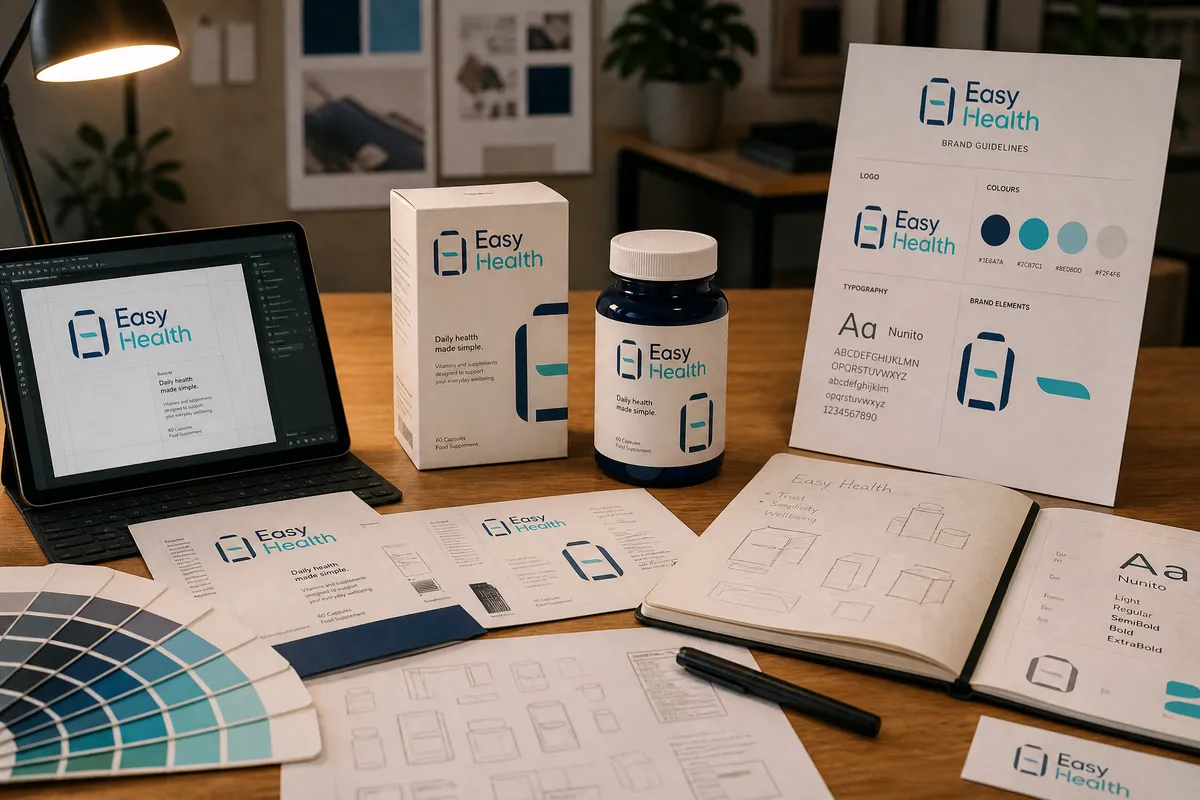
It's competitive.Food PackagingThe market, the "follower" strategy, is very difficult to succeed. You have to create unique visual recognition in the class: reverse strategy: when the whole class is warm, it's cold. When competitions are highlighting "traditionals", they express "new" in modern language. Structural differences vary: when competitions are in a standard box format, they attract eyeballs in an alien package. However, attention should be paid to the Project Considerations of production of an alien package and the suitability of the shelf. Cross-border: Using other types of design language. For example, very simple aesthetic applications for skin protection are used in high-end food packaging, or in future applications for technology products to functional foods. We need to implement differential strategies.Hong Kong Packaging CompanyEASY HEALTHHealth Supplement Packaging、Food PackagingandCosmetics PackagingThree types of product, which integrate the design of different types into your product.

Strategy 5: Create Series Design as a Brand Asset
Single package design is only the starting point, and serial design is a long-term brand asset. The core principles of the serialization design: The unified brand elements: Logo position, brand colour, and font system are consistent on all products, allowing consumers to recognize "this is the same brand" at first glance. Differential product recognition: division of products by colour code (different colours for different tastes), pattern system (different pattern for different product lines) or structure modification (different patterns in different packaging forms). An extended design system: the design takes into account possible new product lines in the future, and leaves room for an expanded visual system. With you.Packaging CompanyWhen working together, it is suggested that branding design codes (Brand Packaging Guidelines) be developed from the outset, rather than individual product-by-product design. So each new product is listed quickly to produce brand-modified packages while maintaining a single view of the series.
Article Recap
- The commercial value of food package design is severely underestimated.
- Strategy 1: The precision of color psychology
- Strategy 2: Material language transmission branding
- Strategy 3: Scientific Information Hierarchy Design
- Strategy 4: Visual Expression of Differentiated Positioning
Easy Health Editorial Team
Easy Health — a Hong Kong health-supplement manufacturer offering one-stop OEM/ODM, formulation development and packaging services.
Evidence used for product planning should identify the original study or guidance, its scope and its limitations. Review proposed product claims separately before approving label copy.
Food Package Design Guide FAQs
How is food packaging design assessed on a per-project basis?
It depends on complexity. The scope is assessed per project and confirmed by the client manager based on the design deliverables. Entry-level (single-side label) → mid-complexity (box structure plus multi-panel design) → high-end custom (including brand strategy and series design). Choosing a packaging company with in-house design usually offers better integration and schedule control than pairing an independent design studio with a contract manufacturer.
Will package adaptations affect current consumers?
Yes, but the impact can be controlled. It is recommended that core brand elements (Logo, main color) be retained to ensure recognition; that pre-releases be made through social media; and that the transition period be set to allow old packages to be stored. Research shows that successful package upgrades can lead to an increase in sales of 15-30%.
How to test the market effects of package designs?
Recommended methods: 1. The shelf simulation test (place the design into virtual shelf environmental assessment recognition); 2. A/B tests (two versions of small batch production are designed to be sold in the same channel); 3. Focus groups (the target consumer is invited to comment on the design).
What are the legal restrictions on food package design?
The main limitations are that the product image should not exaggerate the material (e.g., zooming in on the proportion of food); that health claims must be based on science; that it should not create confusion by imitating well-known brand designs; and that food packages for children should be subject to extra restrictions (e.g., that cartoon characters should not be used too much to attract children).
Want to know more about contract manufacturing?
Our professional team will provide you with free counselling at any time.
Free WhatsApp Consultation