
Supplement Certification FAQ for Export
Planning
There are frequently asked questions about factory certification, product testing, export documentation and international market regulations.
Last update: July 2026 read: about 6 minutes
Certification and Export Requirements Overview
In the global health market, factory certification and export regulations are key factors for successful brand entry into the international market. There are different legal requirements for the import of health goods in different countries and regions, ranging from factory certification to product testing, from labelling to export documentation, and each section requires professional knowledge and experience.
Many international certifications, such as FSSC 22000, GMP, HACCP, ISO 22000, ISO 9001, have been successfully exported to over 30 countries and regions. Our legal team is familiar with the health code of major markets and provides clients with the full range of services from certification support to export documentation.
Here are the most frequently asked questions about certification and export. If you plan to export the product to a specific market, please contact our team in advance to understand the specific requirements of the target market and to avoid delays due to regulatory issues.
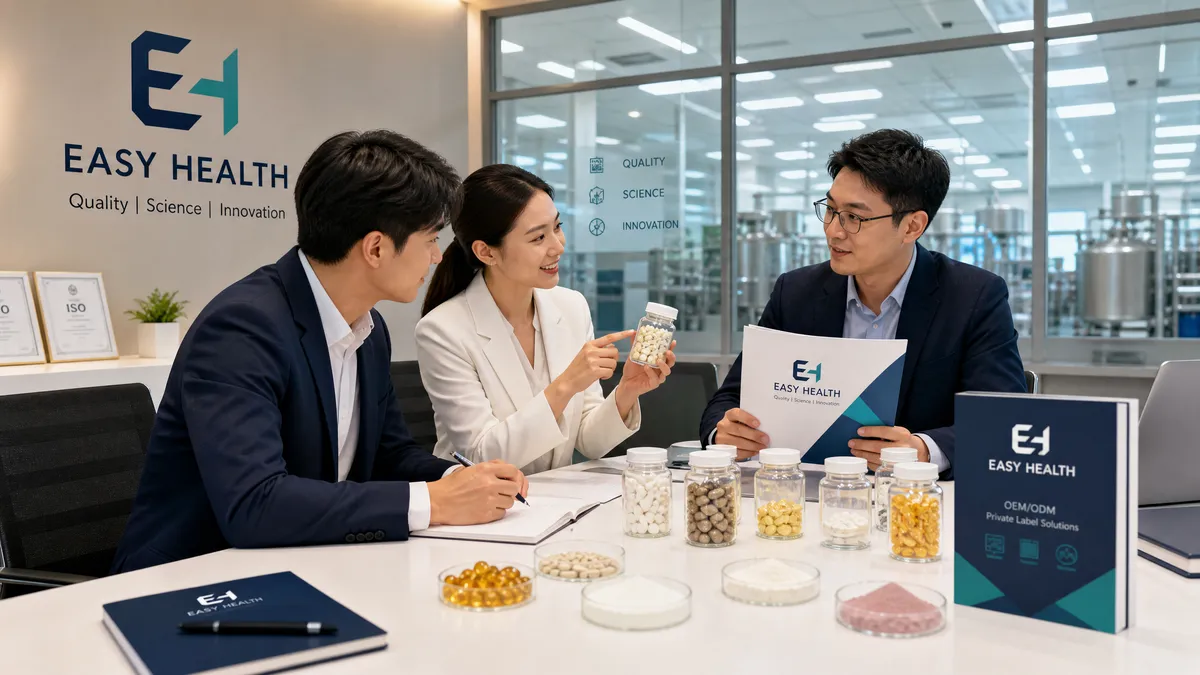
health supplement providers often see specialist answers to questions.

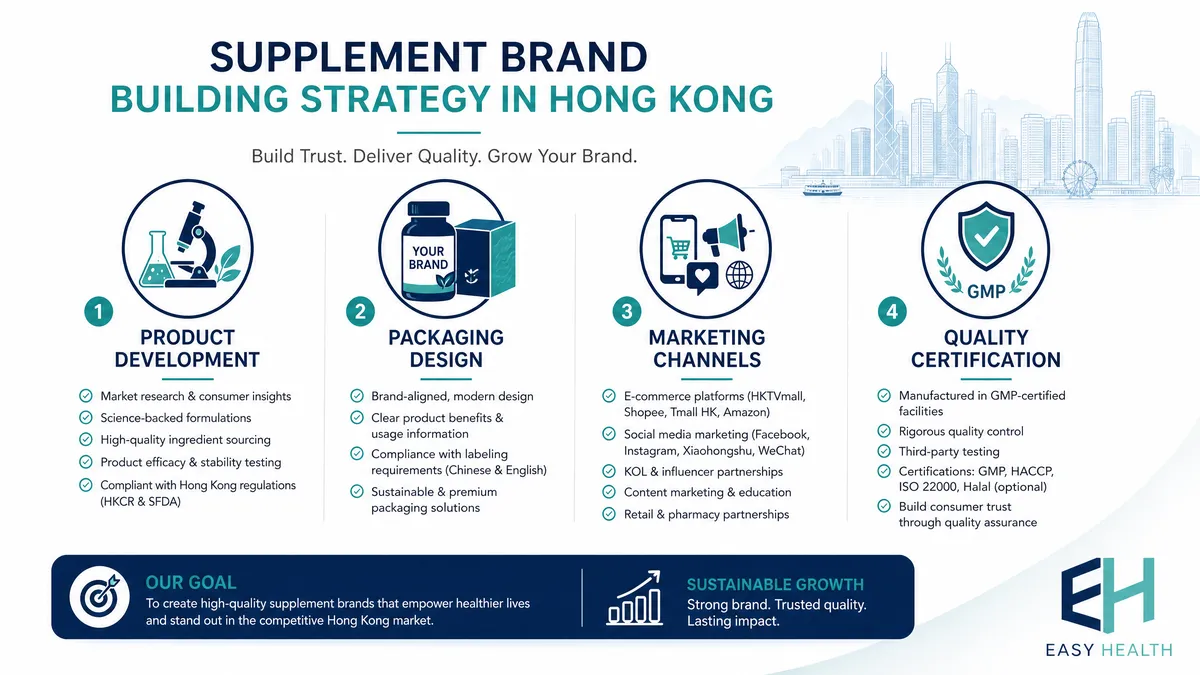
EASY HEALth Healthcare Branding Service

Natural health commodity formulation
GMP Supplement FAQ on Facility Certifications
What international accreditation do you hold on time?
We have multiple international certifications such as FSSC 22000 (food safety system certification), GMP (good production practices), HACCP (hazard analysis key control points), ISO 22000 (food safety management), ISO 9001 (mass management). Among them, FSSC 22000 is one of the highest levels of safety certification in the current food industry and is recognized by the GFSI.
FSC 22000, what's the point of certification?
FSSC 22000 is recognized by GFSI (Global Food Safety Initiative) and accepted by major global retailers and brand owners. Holding this certification enables smoother access to international markets and serves as the highest endorsement of product quality. Walmart, Costco, Watsons, and others require suppliers to hold GFSI-recognized certification.
Can I get a certificate for your client?
We can share facility certification documents and scope summaries relevant to your project for due diligence, site access or export application packs. Factory visits can be arranged by appointment, subject to availability and confidentiality requirements.
How often do you update the certificate?
All certifications are subject to annual monitoring and re-certification every three years. We maintain all certifications and ensure that quality management systems continue to operate. You can always ask for a copy of the latest certificate.
Product Testing and Quality Control Questions
Is every batch tested?
Yes. Every batch undergoes triple quality control: IQC (Incoming Quality Control), IPQC (In-Process Quality Control) and FQC (Final Quality Control). This is a basic requirement of our quality management system; no steps are omitted. Even the smallest batch orders follow the full triple inspection.
Can you arrange a third-party inspection?
Yes. We can arrange internationally accredited third-party laboratories such as SGS and Intertek to conduct microbiological, heavy metal, pesticide residue and assay/content testing. Applicable items will be assessed according to the product and target market requirements, and the resulting reports can support export customs clearance and product registration.
What does the inspection report contain?
The standard inspection report contains basic information on the product, the items and methods of testing, the results of testing, criteria for determination, conclusions. This can be done by adding specific detection items or custom reporting formats to client needs. All reports are signed by quality managers.
Supplement Export FAQ on Documents and Market Entry
Which countries can be exported?
We plan projects for exports to markets in South‑East Asia (e.g. Malaysia, Singapore, Thailand), the Middle East (e.g. UAE, Saudi Arabia), Europe, North America (e.g. US, Canada), Australia and Mainland China. Regulatory requirements differ by market; we can help plan documentation and testing accordingly.
What documents do you need for the exit?
Basic export documents include: CHKO (Certificate of Hong Kong), FehB 311 (Health Certificate), FSC (Free Sale Certificate). Some markets may require additional documents such as Halal certification, COA (analysis certificate), proof of origin, etc. We're offering a three-certificate service.
How long does it take to run the Three Export Certificates?
CHKO: approximately 5–7 working days; FEHB 311: approximately 3–5 working days; FSC: approximately 5–7 working days. We can process these concurrently, with a total lead time of about 7–10 working days. We recommend beginning document preparation before production is completed to avoid shipment delays.
What does it take to export to China?
Health care exports to mainland China require the preparation or registration of imported health foods. The program is used for life-support minerals products (about 3-6 months) and for functional health products (about 12-24 months). We can assist in the preparation of a full package/registration document.
Halal, can you confirm?
We can support planning for Halal certification with recognised bodies for markets such as Malaysia, Indonesia and parts of the Middle East. Certification requires that raw materials and production processes meet Islamic requirements; timeframes depend on the certification body and project scope.
Export Market Regulations and Document Requirements
| Market | The main law. | Documentation requirements | Time of operation. | Special requirements |
|---|---|---|---|---|
| Southeast Asia | National food laws | CHKO + FEHB 311 | Timeframe varies by market and authority | Halal |
| Mainland China | Health Food Management Approach | Backup/Registration | 3-24 months | Chinese Tag |
| America | DSHEA / FDA | FDA Register + NDI | Timeframe varies by market and authority | cGMP Code |
| EU | Food Compensator Directive | CE + Regular Statement | Timeframe varies by market and authority | Novel Food |
| Japan | Food Hygiene Act | Enter + Epidemic | Timeframe varies by market and authority | Japanese tag |
| Middle East | National food standards | Halal + FSC | Timeframe varies by market and authority | Halal certification |
Export Regulatory Planning Tips
- Advance planning: Export documents take time to process, and it is recommended that relevant documents be prepared before they are produced, so as not to delay delivery.
- Understanding the target market: the laws of different markets vary widely, and knowing in advance the rules that avoid formulas and labels.
- Keep complete records: Export products require complete production records, inspection reports and quality documentation, and recommend records management from the time of production.
- Consider Halal: If you plan to export South East Asia or the Middle East market, Halal's certification is almost necessary, it is recommended to consider it in the formula design phase.
- GFSI-recognised schemes such as FSSC 22000 can help demonstrate robust food safety management to buyers and regulators, which may ease documentation reviews in some markets. Always confirm the required scheme and scope for the target market.
Certification and Export Support Questions
Our professional team will answer any questions about health supplement contract manufacturing for you at any time.
WhatsApp EnquiryRelevant Page Recommendations
OEM Manufacturing Services
Provide the formula, we produce it.
Learn MoreODM Formula Development Services
One-stop service from formulation design to finished product
Learn MoreOne‑Stop Contract Manufacturing Process
Understanding the full collaborative process and timeline
Learn MoreKnowledge Hub
In-depth articles and guides for the health profession
Learn MoreOEM vs ODM Distinction
Understanding the differences between the two manufacturing models.
Learn MoreHow to make supplement brands
Hong Kong's complete business guide
Learn MoreAbout Easy Health
Know our history and team.
Learn MoreFactory Tour
Anticipate access to FSSC 22000 certification facility
Learn More