Children's supplement packaging for clear caregiver use
Children’s supplement packaging is about more than cute visuals. Safety, dosing clarity and caregiver readability come first. From our Hong Kong facility, we coordinate bottles, pouches, sticks, blisters, boxes and labels, with child‑resistant features, tamper evidence, moisture and light protection, and labelling aligned with Hong Kong and Mainland practices. Timelines vary by project and are confirmed by your account manager.
Summary:This page helps you execute children’s supplement packaging with safety, child-resistance, clarity, and compliance. It offers bottle, pouch, stick, and blister formats, sampling and production coordination, tamper-evident options, and project-by-project assessment within a Hong Kong GMP and FSSC 22000 framework.
What should you decide first for children's vitamin packaging?
Start with dosage form (gummies, chewables, powder, syrup/drops), daily serving and usage context (at home or on‑the‑go). Then define safety and convenience: child‑resistant closure (e.g., push‑down‑turn caps or specific blister formats), tamper evidence, desiccant, and dosing aids (spoon/dropper). For labels, align with Hong Kong Cap.132W and the “1+7” nutrition scheme, and consider Mainland GB 7718 and GB 28050 differences. Next select materials and barriers (HDPE/PET, foil pouches, alu blisters) and any secondary carton for protection.
Child-resistant and tamper-evident options to verify
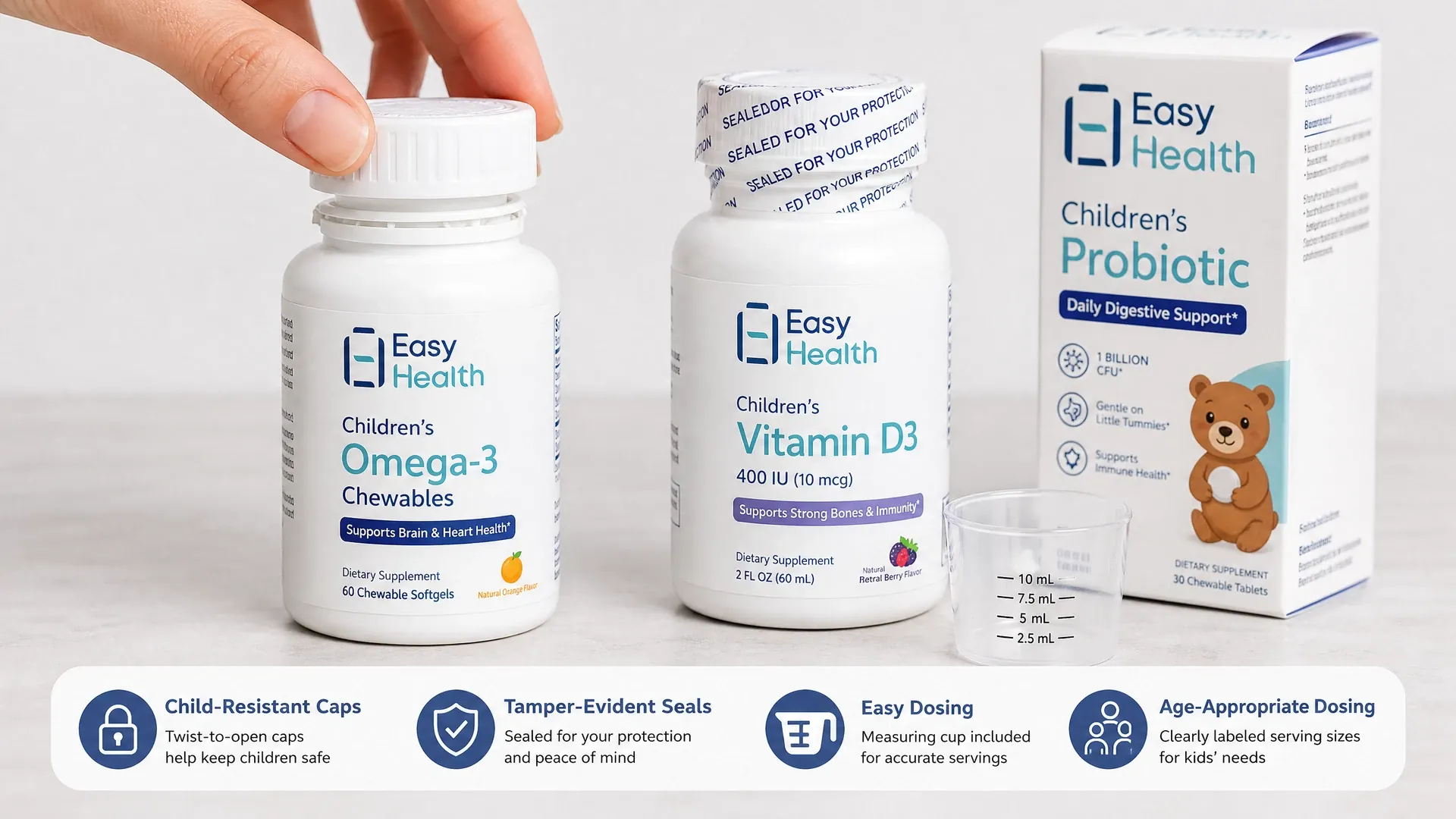
For children’s supplement packaging, reduce unintended opening and ingestion without hindering caregiver use. Typical options: bottles with push‑down‑turn child‑resistant caps, extended necks for torque control and labels with reinforced edges; blisters that require peel‑then‑push; pouches with rounded corners and concealed notches to moderate tear initiation. Add tamper‑evident bands or security seals to show first opening. Target opening forces should balance ‘adult-manageable’ and ‘child‑difficult’. We recommend torque/peel/push benchmarks and prototype tests by age group and product form.
- Cap torque must be consistent over cycles
- Notch + material stack define tear force
- Blister format must suit tablet hardness
- Combine CR features with tamper evidence
Dosage forms and materials: barrier and usage trade-offs
Each format demands specific priorities. Gummies/chewables need moisture and light protection: PET/HDPE bottles with foil induction seals and desiccants work well. Powder sticks emphasise portability and portioning with alu‑laminate films for O2/H2O barrier. Syrups/drops are light‑ and oxygen‑sensitive; choose amber PET/glass with dripper inserts and leak‑control. Large family pouches require reseal reliability and space for dosing aids; blisters support fixed daily servings but check child finger strength. Add rounded corners, wider spouts, or anti‑stick inner layers to improve real‑world use.
- Gummies need moisture control
- Sticks prioritise on‑the‑go portions
- Syrups need light protection + drip control
- Family pouches need strong reclosure
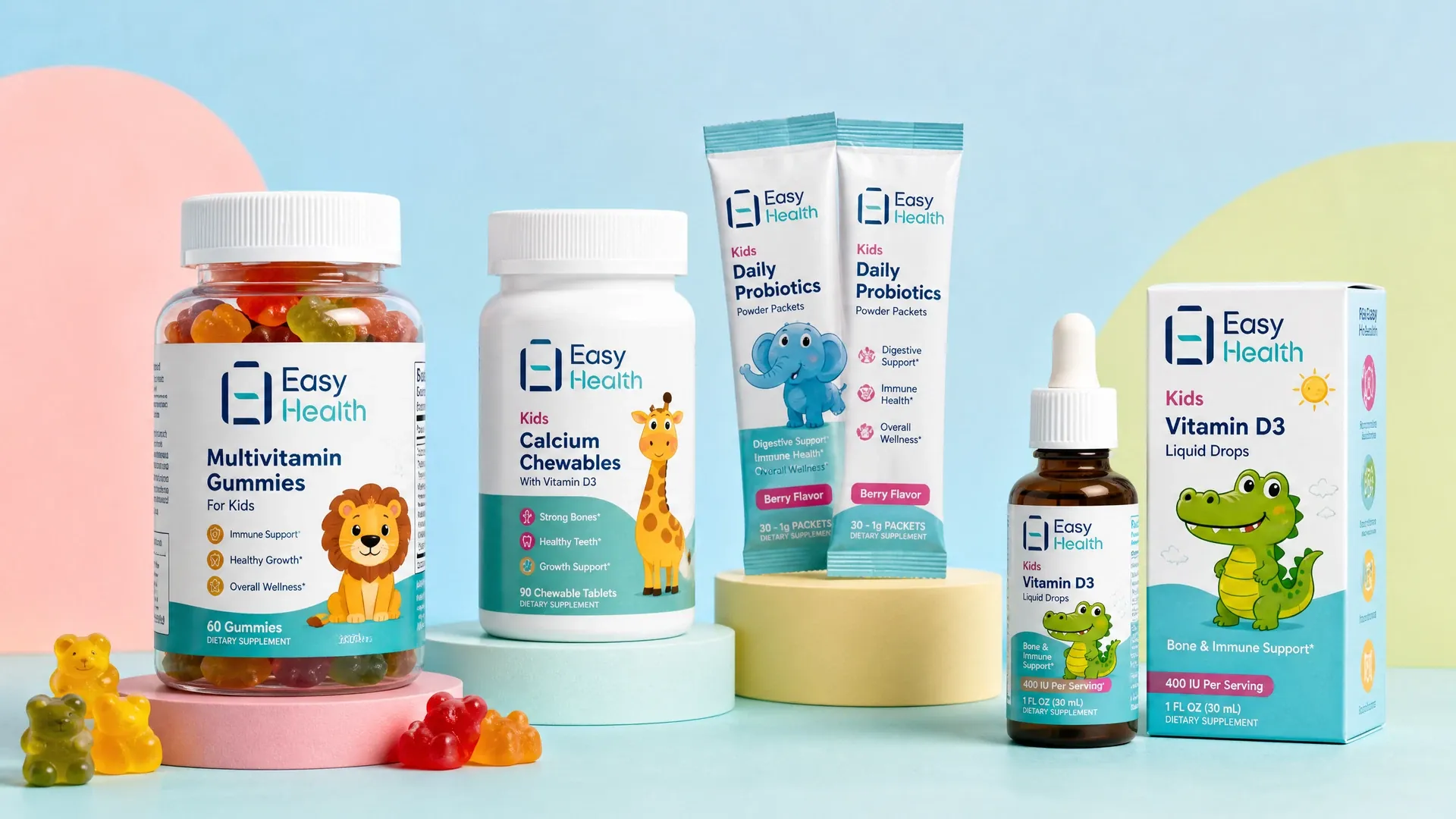
Visual guide to pack choices by dosage form
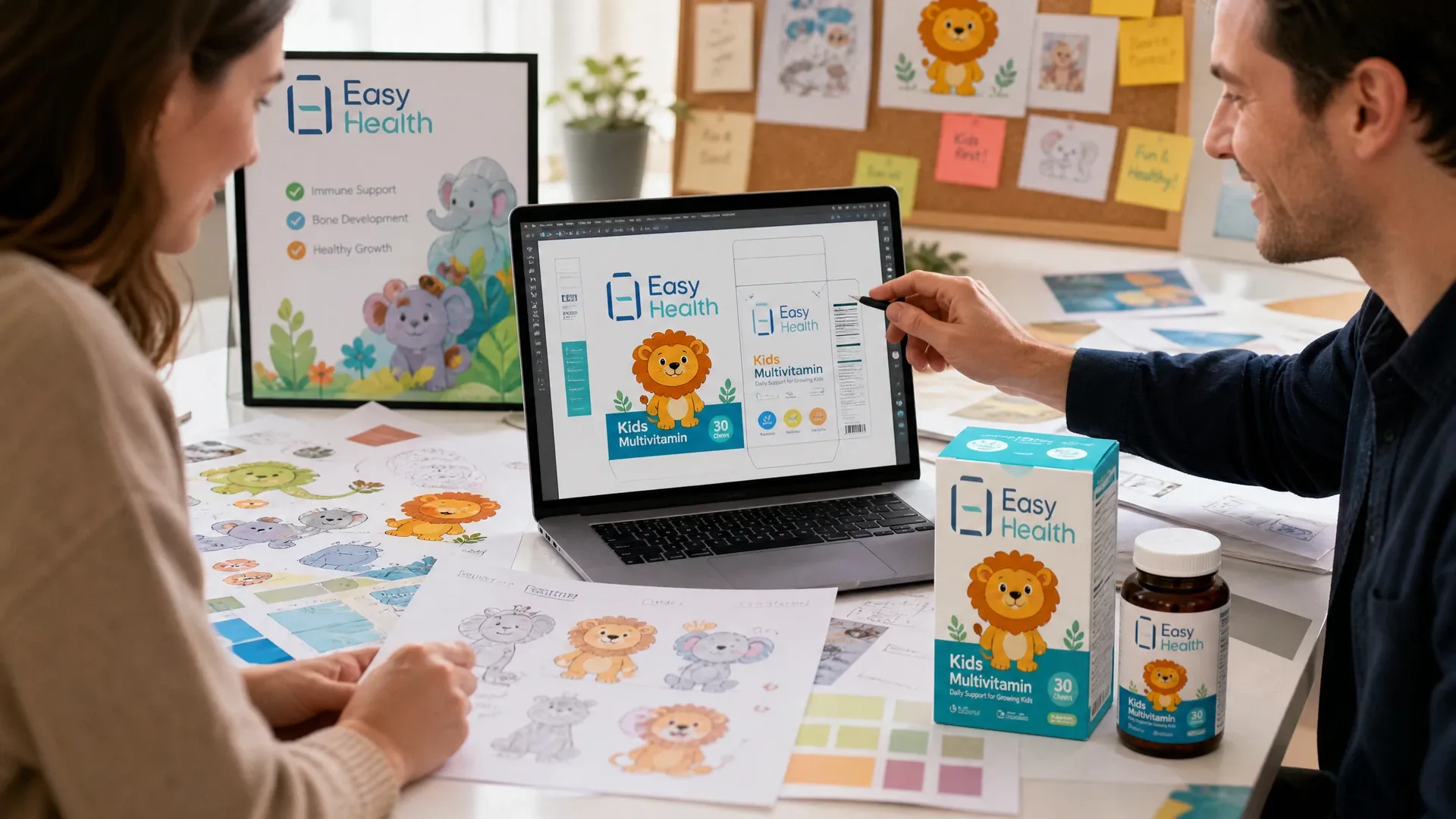
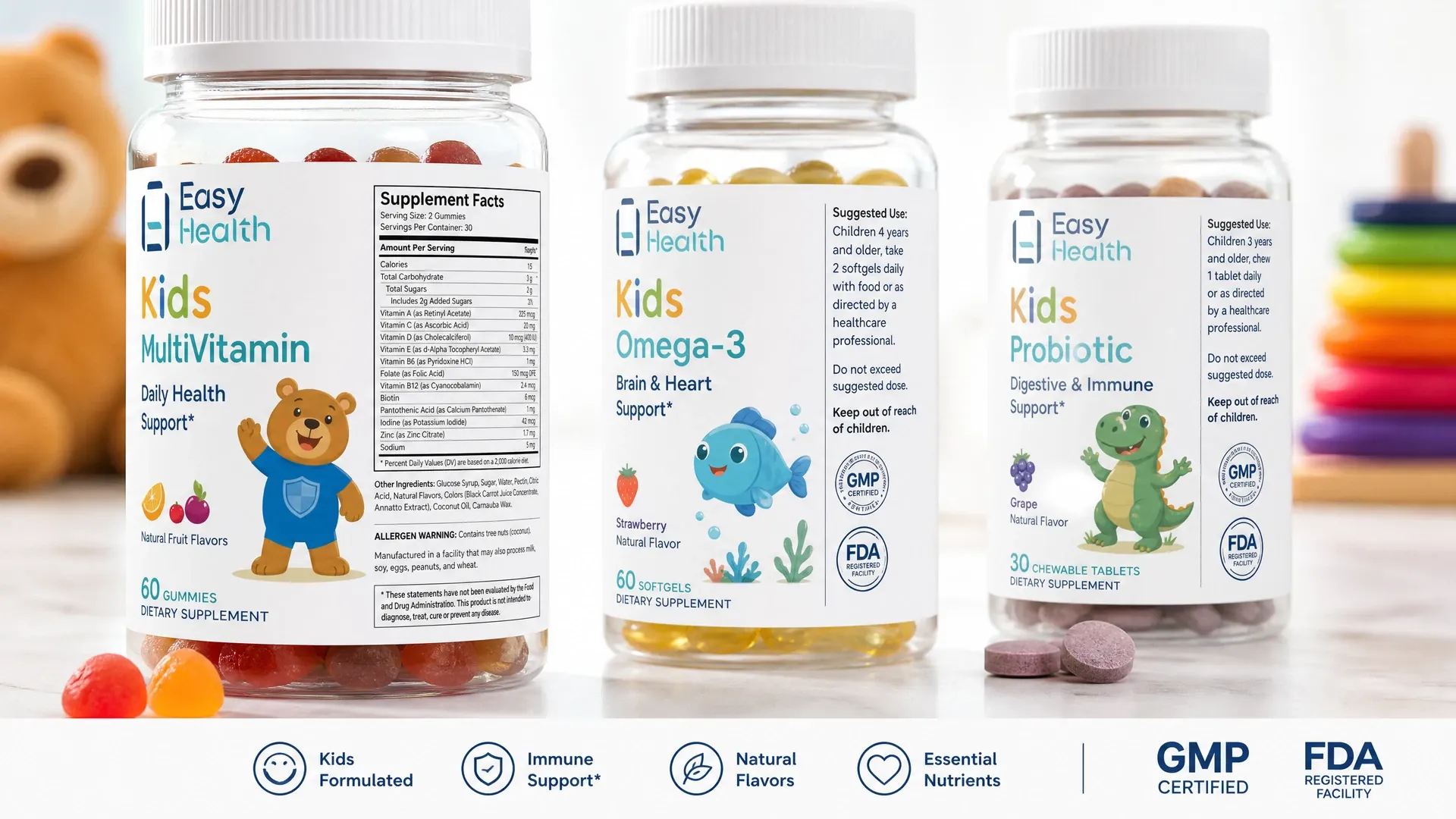
Use the images to review pack choices by dosage form, child‑resistant mechanisms, tamper‑evident options, and which age and dosing details should be highlighted on labels—useful for aligning design and regulatory stakeholders.
Children's supplement label design and readability review
Prioritise caregiver‑critical info in high‑visibility zones with clear type and contrast. For Hong Kong, refer to Cap.132W and the “1+7” nutrition scheme; for Mainland, align with GB 7718 and GB 28050 formats. Use icons for daily servings and tools (spoon/dropper), age guidance, allergen warnings, storage and cautions. Avoid misleading visuals or medical claims. Material choices include scuff‑resistant labels with rounded edges to prevent lift; cartons can feature bilingual layouts and parent tip boxes.
- Place and size the ‘1+7’ panel
- State age groups and servings
- Allergens, storage and cautions
- Bilingual layout with high contrast
Sampling checks before approving the pack
Before mass production, run prototypes and functional checks. We coordinate packaging and printed material supply and arrange tests for: cap torque and re‑closure consistency; induction seal integrity and heat parameters; pouch tear force and zipper air‑tightness; blister peel/push forces; dropper flow and leak control; and pack integrity after drop, vibration and temperature/humidity exposure. Findings feed back into structure and material stacks to keep ‘adult‑easy, child‑difficult’ and transport robustness in balance.
- Cap torque + seal integrity
- Pouch tear force + zipper seal
- Blister peel/push dual checks
- Transit drop and vibration tests
Our packaging design and coordination workflow
- Briefing and regulatory outline:Define dosage, age group and markets; prelim alignment with Cap.132W, 1+7, and GB 7718/28050 labelling fields.
- Material and structure proposal:Recommend bottles/pouches/sticks/blisters, cartons and label stocks based on barrier, child safety and usage.
- Artwork and compliance review:Provide dielines and layout guidance; review nutrition and caution blocks to avoid misleading claims.
- Sampling and functional tests:Coordinate samples, colour and structure checks; run torque/peel/seal tests and refine as needed.
- Packaging production coordination:Coordinate materials and packaging production per the approved plan; timelines vary and are confirmed by the account manager.
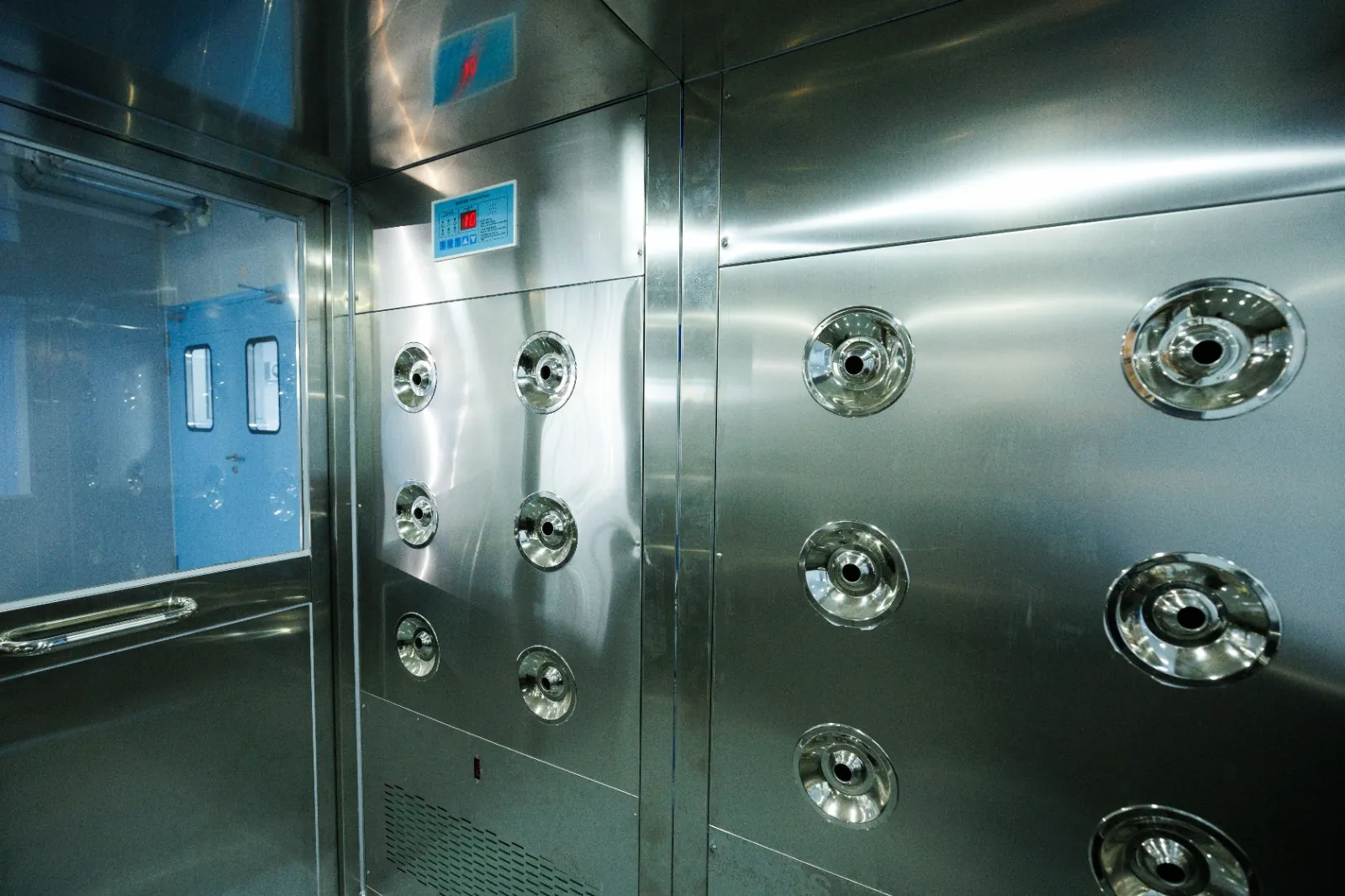
Inside the Easy Health Hong Kong Facility


Quick guide to dosage forms and pack formats
| Dosage | Suggested pack | Child‑safety focus | Aids/structures |
|---|---|---|---|
| Gummies | PET/HDPE bottle + foil seal | CR cap + desiccant | Rounded label, neck band |
| Chewables | Blister or bottle | Peel‑push/CR cap | Foil lidding, calendar |
| Powder sticks | Alu‑laminate sticks + box | Concealed notch, rounded | Single serve, wide spout |
| Syrup/drops | Amber bottle + insert | Leak control + TE band | Dropper/cup with scale |
CR = Child‑Resistant; TE = Tamper‑Evident.
Packaging and label review checklist
- Age group, daily serving and usage context (home/on‑the‑go) confirmed
- Child‑resistant feature and tamper‑evident method selected
- Label includes ‘1+7’ and required cautions; bilingual layout reviewed
- Barrier needs (moisture/light/oxygen) and laminate verified
- Physical samples passed: torque, peel, tear and seal tests
- Dosing aids (dropper/spoon) storage and pictograms planned
Children's supplement packaging FAQs
How should child-resistant structures be assessed?
No. It depends on dosage form and age group. Bottles often use push‑down‑turn caps plus induction seals; blisters can be peel‑then‑push; pouches use concealed notches and higher tear resistance to reduce unintended opening. Combine with tamper‑evident features. Specific solutions and opening force targets are confirmed by your account manager after prototyping.
Which labelling points need market-specific review?
For Hong Kong, refer to Cap.132W and the ‘1+7’ nutrition scheme; for Mainland, review GB 7718 and GB 28050. Clearly state age group, daily serving, allergens, storage and cautions, and avoid medical or misleading claims. Final content and layout should be reviewed with our account manager.
Which pack functions can be checked during sampling?
Typical checks: cap torque/reclosure, induction seal integrity, pouch tear force/zipper seal, blister peel/push forces, dropper flow/leak control, and carton drop resistance. Exposure to temperature/humidity can be used to observe changes and refine materials/structures.
How can gummy and chewable packs manage moisture?
Choose moisture‑barrier containers with reliable closure (e.g., foil induction seal) and add suitable desiccants. Indicate storage conditions and ‘close tightly’ on the label. For pouches, use high‑barrier laminates and ensure clean, well‑aligned zipper sealing. Tip cards in cartons can remind caregivers to reseal promptly.
How should I prepare artwork files?
Supply dieline‑based layouts with bleed and safe areas. Use CMYK/spot colour specs and 300 dpi rasters. Provide regulatory and warning text as editable copy. Digital or wet proofs can be arranged at sampling to confirm colour and small‑type legibility.
Related Packaging Services
Discuss your children's supplement packaging project
Share your dosage form, age group and markets. From our Hong Kong facility, Easy Health coordinates children’s vitamin packaging, labels and cartons, evaluates child‑resistant and barrier needs, and arranges sampling and packaging production. Timelines vary by project and are confirmed by the account manager.
Last updated: