
Cosmetic Packaging Materials Guide: From Bottles to Boxes

Key Takeaways (TL;DR)
Cosmetics packaging materials should be assessed across three dimensions: product compatibility, consumer experience and brand positioning. An unsuitable material can cause product degradation—for example, incompatibility between a serum and certain plastics—poor usability such as pump blockage, or a mismatch with the brand image. This guide provides practical material-selection advice for cosmetics brands.
Cosmetics packaging materials should be assessed across three dimensions: product compatibility, consumer experience and brand positioning. An unsuitable material can cause product degradation—for example, incompatibility between a serum and certain plastics—poor usability such as pump blockage, or a mismatch with the brand image. This guide provides practical material-selection advice for cosmetics brands.

Basic Types of Cosmetic Packaging Materials
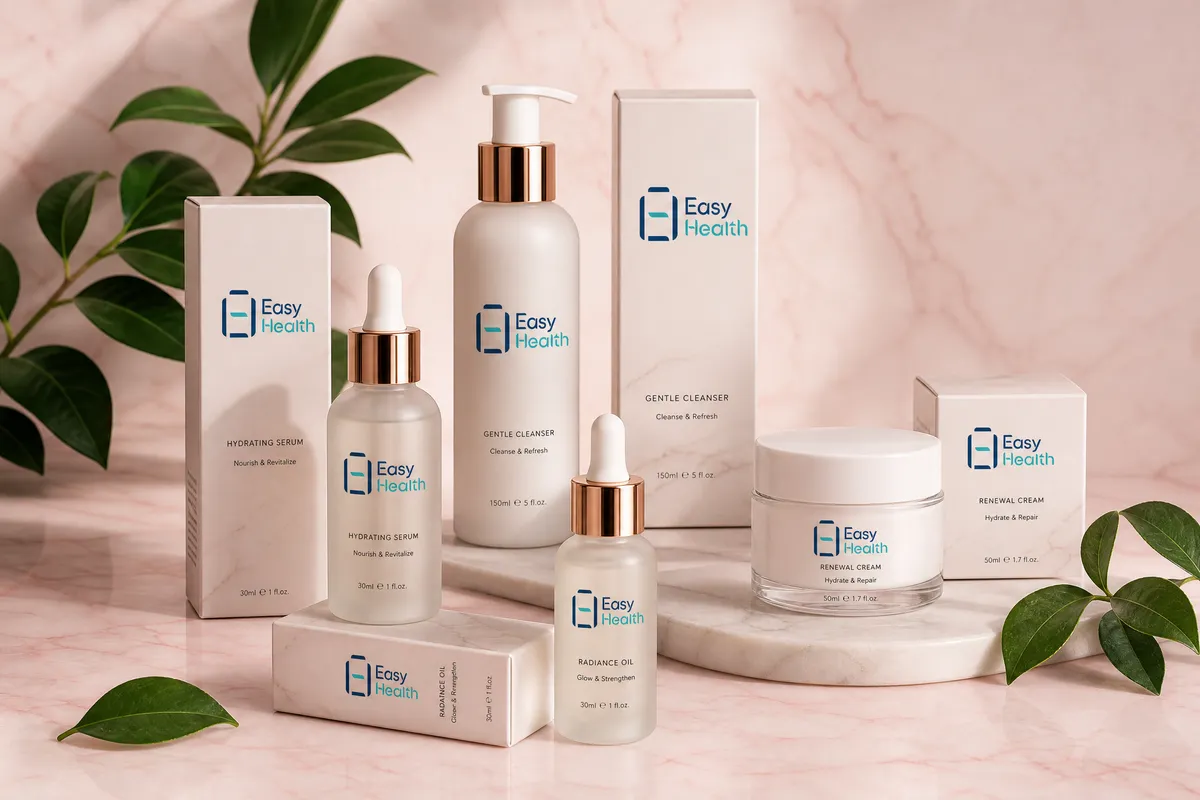
Cosmetic packaging materials fall into four main types: Glass — the highest chemical stability, suitable for serums with actives such as vitamin C and retinol, and for premium products. Drawbacks: heavy, fragile, and higher production complexity. Plastics — many types (PP, PE, PET, PETG, AS, ABS), each with pros and cons. The most common materials for cosmetics, with moderate overall complexity and flexible design. Metals — mainly for aerosol cans (aluminium) and premium cream caps. Pleasant feel and strong barrier properties. Paper/bamboo/wood — eco-friendly materials used for cartons and some caps. Their application has grown with the shift toward sustainable packaging.

How to Match Cosmetic Packaging Bottles to Product Types
Serum — Recommended: dark glass bottles (amber/blue) with dropper caps. Reason: Glass is generally inert and the darker colour helps block ultraviolet light; droppers enable convenient, precise dosing. Emulsion/cream — Recommended: PP wide‑mouth jars or acrylic bottles with inner lids. Reason: PP is chemically stable and acrylic offers a premium look; wide openings are easy to access and inner lids help limit air exposure. Sunscreen/body lotion — Recommended: PE tubes or PP pump bottles. Reason: Tubes are easy to squeeze and carry, while pump bottles suit larger capacities. Liquid foundation — Recommended: glass bottle with pump or PETG bottle. Reason: Glass gives a premium feel and pumps allow controlled dispensing; PETG provides glass‑like clarity but is lighter. Perfume — Recommended: crystal glass with a spray pump. Reason: The strong refraction and weight of crystal glass convey a premium perfume presentation.
| Topic | Key Summary |
|---|---|
| Basic classification of cosmetic packaging materials | Cosmetic packaging materials are mainly divided into four categories: Glass — offers the highest chemical stability and is suitable for serums and premium products containing active ingredients (e.g., vitamin C, retinol). Disadvantages. |
| Unknown Material | Skincare serums — Recommendation: dark glass bottles (amber/cobalt blue) with dropper caps. Reason: glass does not react with active ingredients; dark glass blocks UV. Droppers allow precise. |
| Compatibility test for cosmetic packaging | Compatibility testing is the most critical phase in cosmetic packaging development. Tests include: Chemical compatibility — exposing the product and packaging materials to accelerated conditions (40°C/75%. |
| Environmental trends in cosmetic packaging | Refill — An increasing number of brands are introducing refillable designs: consumers purchase replacement inserts while reusing the outer casing. This not only reduces environmental impact but also lowers consumers' repeat purchase. |
Why Is Compatibility Testing Important for Cosmetic Packaging?
Compatibility testing is the most critical part of the makeup package development. Tests include: Chemical compatibility - exposure of products and packaged materials under a acceleration condition (40°C/75% RR) for 3-6 months to detect chemical reactions (change, taste, pH transformation, degradation of active constituents). Physicocompatibility - Tests whether packaged materials are adsorbed to the product composition (e.g. some plastics are adsorbed with perfume) or releases the substance to the product (e.g. plasticizer migration). Functional tests – whether the pump is blocked by the product, whether the sealing of the bottle is affected by the product, and whether the label is dissolved by the product. Problems are often encountered: the oxidation reaction of vitamin C and certain plastic bottles leads to yellowing; the dissolution of PS-based products with refined oils; and the blocking of mouth pumps by high viscosity products.
Need a Professional Manufacturing Solution?
Complimentary project consultation with dedicated follow-up based on your product needs. Small-batch sampling is available, and production batch sizes are confirmed per project.
Sustainable Trends in Cosmetic Packaging Materials
Refill — More brands are adopting refillable designs where consumers replace only the inner component and reuse the outer shell. This is not only eco-friendly but also reduces the burden of repeat purchases, enhancing brand loyalty. PCR materials — The proportion of Post-Consumer Recycled plastics continues to rise. The EU has mandated that by 2030 cosmetic packaging must contain at least 30% PCR content. Mono-material design — Using a single material (such as all-PP) to facilitate recycling and avoiding mixed materials that hinder recyclability. Bio-based materials — Sugarcane-based PE, corn-based PLA and similar options are maturing, with significantly lower carbon footprints than petroleum-based materials. Lightweighting — Reducing material usage while maintaining function, such as thin-wall bottles and lighter glass.

Surface Finishing Techniques for Cosmetic Packaging
Sandblasting/frosting — Creates a delicate matte texture on glass or plastic, with a smooth touch and misty visual effect. Suitable for premium skincare and fragrances. Electroplating — Applies a metallic layer (gold, silver, rose gold, etc.) to caps or bottles for a luxurious feel. Note: plating can affect recyclability. Hot stamping/foil — Applies metallic foil to cartons or labels to highlight the brand logo or key information. Refined effect and widely used. UV transfer — Prints fine patterns and gradients on the bottle with near photo-quality results, ideal for brands needing complex graphics. Screen printing — Directly prints text and graphics on the bottle with strong durability, suitable for minimalist designs. Water transfer — Enables full-coverage printing on irregular surfaces, suitable for uniquely shaped containers.

How to Choose a Cosmetic Packaging Supplier
The key considerations when choosing a cosmetic packaging supplier include: 1) ISO 22716 (Cosmetics GMP) — look for evidence of procedures aligned to this standard for hygiene and quality management. 2) Material availability — whether the supplier keeps ready stock of standard bottles and accessories for quick sampling and dispatch. 3) Customisation capability — support for custom moulds, special finishes and small production runs. 4) Quality consistency — control of colour differences, dimensional tolerances and surface quality between batches. 5) Environmental options — availability of sustainability choices such as PCR materials and FSC‑certified paper. Easy Health’s cosmetic packaging service covers bottle selection, surface finishing, label design and outer box production, providing a one‑stop path from concept to product.
Article Recap
- Basic classification of cosmetic packaging materials
- Unknown Material
- Compatibility test for cosmetic packaging
- Environmental trends in cosmetic packaging
- Surface processing techniques for cosmetic packaging
EASY HEALTH
Easy Health is a Hong Kong health‑supplement manufacturer offering one‑stop OEM/ODM, formulation development and packaging services.
Evidence used for product planning should identify the original study or guidance, its scope and its limitations. Review proposed product claims separately before approving label copy.
Cosmetic Packaging Materials FAQs
What's the most common material in makeup?
The most common problem is the quality of the product due to poor material compatibility. For example, refined oil-containing products dissolve certain plastics, vitamin C. Precision turns yellow in transparent bottles, high viscosity products block pumps. It is suggested that an accelerated stabilization test of 3 months be conducted before production.
Which one of those bottles is better for skin protection?
It depends on product type and brand positioning. Quality fluids with active ingredients are recommended in dark-coloured bottles (the most chemically stable); in everyday skins (face cream, emulsions) it is possible to use a PP or an Acrystal bottle (easily, non-fragile); and in high-end brands to the glass bottle (mass, environmental).
How are starting quantities for cosmetic packaging confirmed per project?
Standard bottles (in stock): rapid to launch, with small-batch sampling available. Custom-mould bottles: involve moulds and timeline planning, with production volumes assessed per project. Label/carton printing: production volumes and processes are confirmed by the client manager based on design and quantity. For new brands, we recommend starting with standard bottles plus custom labels to reduce initial risk.
How to make cosmetics more environmentally friendly?
1. Use PCR materials (post-consumer recycled plastic).\n2. Design a replaceable/refillable system.\n3. Select a single material to facilitate recycling.\n4. Use FSC-certified paper for outer boxes.\n5. Reduce unnecessary packaging layers.\n6. Use water-based inks and eco-friendly adhesives.
What are the rules for making up?
Hong Kong cosmetics are subject to the Consumer Safety Ordinance. The label must contain: product name, composition list (INCI name), clean content, manufacturer/importer data, method of use, and attention. Exporting the EU is also subject to EC 1223/2009 makeup law.
Want to know more about contract manufacturing?
Our professional team will provide you with free counselling at any time.
Free WhatsApp Consultation