Supplement Sachet Packaging for Single-Serve Products
This page focuses on the specifics of supplement sachets and stick packs, helping you balance foil-laminate barriers, format and sizing, opening experience, outer-box display and logistics. Easy Health coordinates the project requirements in Hong Kong. Confirm which certificate scopes, quality records and supporting documents apply to the proposed arrangement. Certificate scope and document evidence are checked per project, and each project is assessed and confirmed by a dedicated account manager.
Summary:A practical guide to supplement sachet and stick-pack packaging: dose size, foil-laminate barrier, tear features, outer-box pairing, and the trade-offs between stick packs and stand-up pouches. Easy Health coordinates the project requirements in Hong Kong. Confirm which certificate scopes, quality records and supporting documents apply to the proposed arrangement.
When Should You Choose Stick Packs or Flat Sachets?
For single-serve and on-the-go use, stick packs suit direct pouring; they also work for fine powders or granules. If the product is mixed into drinks or food, flat three-side-seal sachets offer a wider opening and strong print presence. For shelf-stand and larger fills, choose stand-up pouches. Where high barrier and light protection are needed, select foil or metallised laminates. Final selection should consider hygroscopic/light-sensitive actives, fill weight, tear position, secondary packaging and palletisation together.
Use Cases and Serving Size for Supplement Sachet Packaging
Single-serve is the core value of sachets. Determine fill weight and volume from the recommended intake and solubility, balancing pourability with a finishable dose. For hygroscopic formulas, minimise post-opening exposure and choose compact formats. For variety packs or regimen kits, use outer boxes to organise daily servings and lot identification. For mix-to-drink formats, allow a wider opening and guided tear to prevent clumping. Stick packs suit direct-to-mouth or small-cup mixing; three-side-seal sachets offer wider canvases for information. Stand-up pouches often serve as refills or family packs—define their role against single sticks clearly.
- Fix fill weight and volume
- Plan pouring and dissolution
- Outer box for daily/regimen
- Stick packs excel on-the-go
Foil Sachets for Supplements and Barrier Films
For light-, oxygen- or moisture-sensitive formulas, foil or metallised laminates enhance barrier and light-blocking. Typical stacks include PET/AL/PE or PET/VMPET/PE; add PA for tear resistance and stiffness if needed. Evaluate heat-seal window, interlayer adhesion and compatibility with contents. For fine powders, manage static and dust that can affect sealing by providing headspace and dust-collection edges. Where you need high barrier with partial visibility, use a small window or high-barrier clear films. Final structures should be confirmed via physical samples and stability checks.
- Choose AL/VMPET by light need
- Seal window and adhesion
- Headspace for fine powder
- Sample and stability test
Supplement Stick Pack Packaging Size and Layout Checks
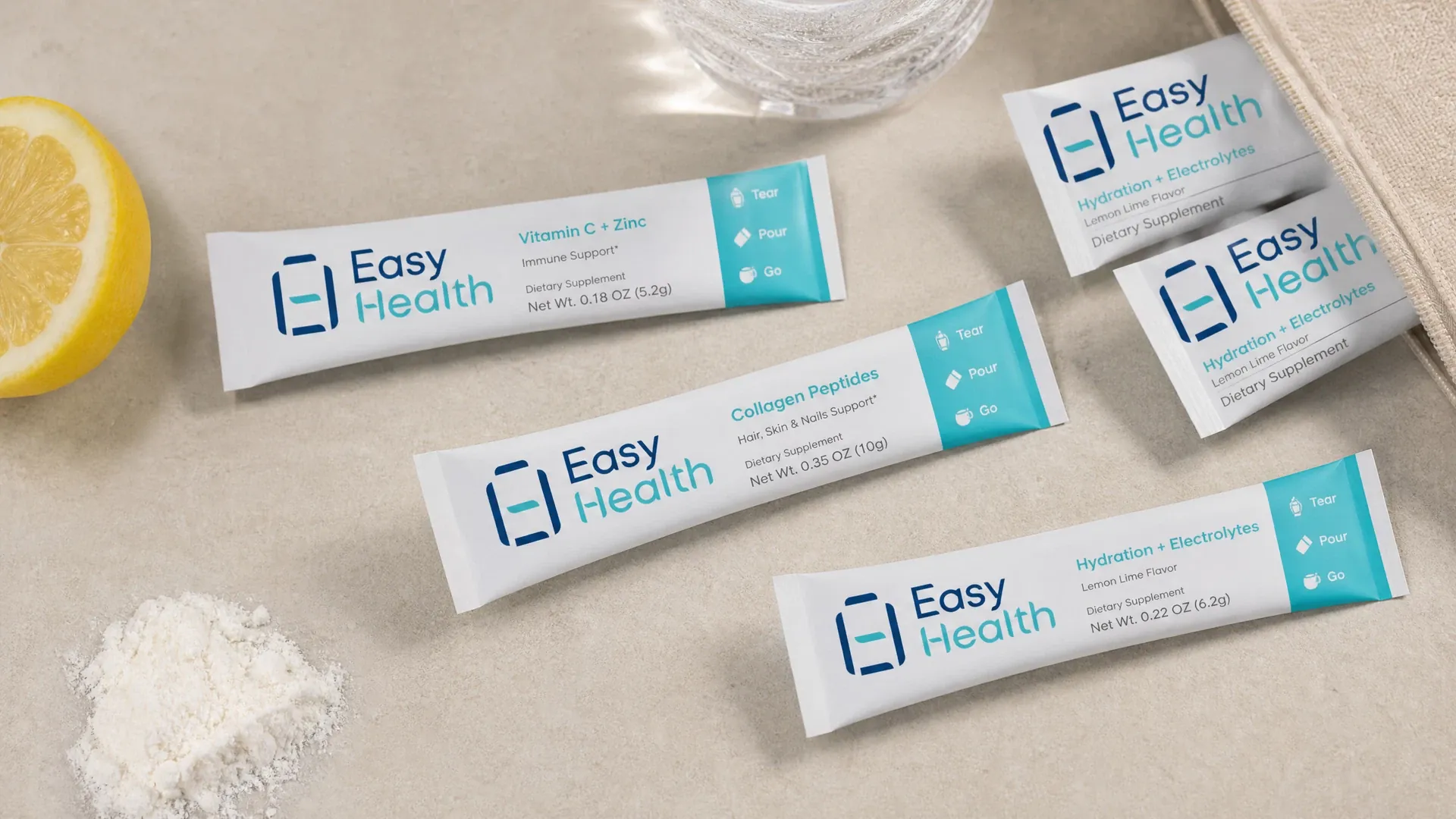
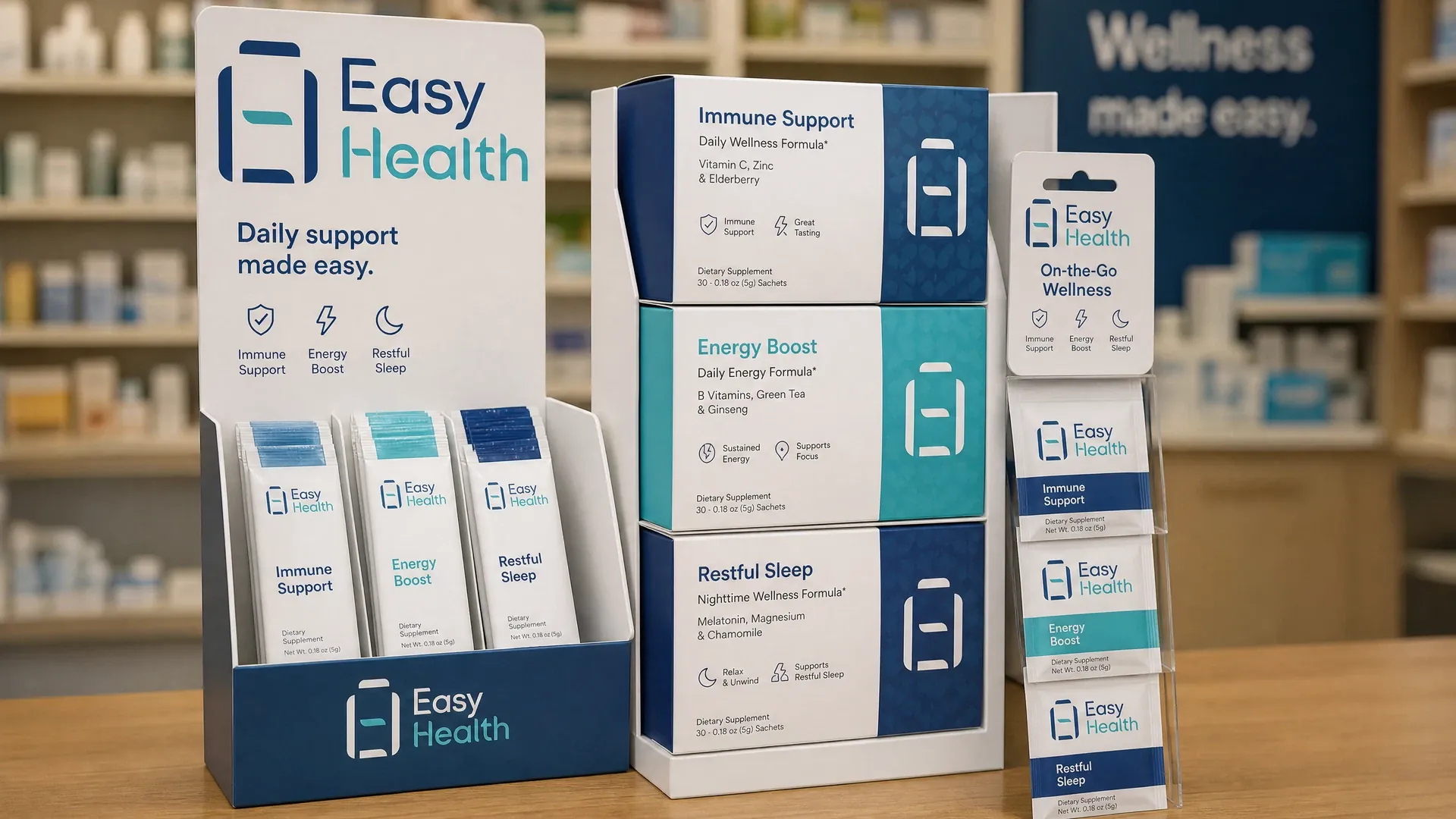
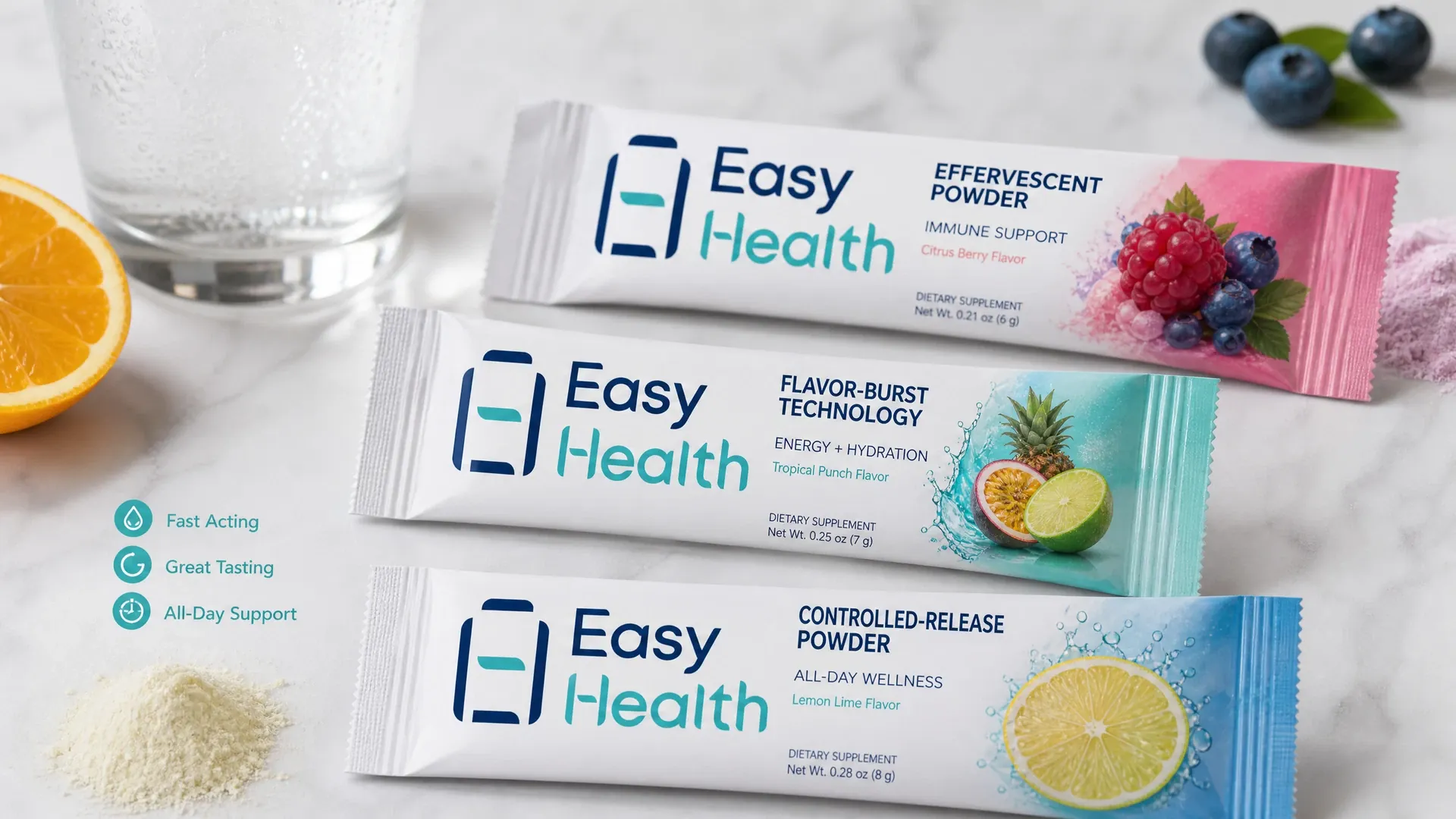
The visuals show automated stick-pack forming, tear-line placement, audience-led information density, and pour paths for innovative powders. Use them to draft aspect ratios, tear direction and outer-carton dispensing before refining with our sampling.

Tear Features and Opening Experience
Opening experience drives repeat purchase. Position the notch away from high-strength seal zones and align with particle size and pour angle. Sticks often use a side V-notch or laser score for first-time success; flat sachets may add dual notches and a curved spout edge to cut dusting. For direct-to-mouth formats, ensure a smooth inner film with neutral odour and comfortable edge feel. Adjust tear force to user groups where relevant. Anti-backflow cut corners and clear single-serve icons encourage finishing in one go. Post-opening advice should remind users to avoid moisture and sunlight, with clear usage directions on the label.
- Place notch off strong seal
- Laser score aids success
- Curved edge reduces dust
- Clear use and warning icons
Outer Cartons for Display, Tracking and Label Space
Single sticks and sachets often pair with outer or display cartons for retail and logistics. Allow proper height and pick angle, and keep the barcode, lot/expiry and daily serving guidance visible. For prepackaged food sold in Hong Kong, labels generally follow the Food and Drugs (Composition and Labelling) Regulations (Cap.132W): Chinese or English may be used, and if both are used, the food name and ingredient list must appear in both languages; nutrition labelling follows the “1+7” scheme unless exempted. If a product falls within the proprietary Chinese medicine category, it is separately regulated under the Chinese Medicine Ordinance (Cap.549), so products containing Chinese herbal ingredients should have their classification confirmed first. For Mainland channels, refer to GB 7718 and GB 28050 for Mainland prepackaged food. For multi-market packs, use language panels or separate artworks, and verify key font sizes, alignment and colour during sampling to reduce print risks.
- Carton height and pick angle
- Clear lot/expiry display
- Follow Cap.132W and 1+7
- Separate SKUs for markets
How We Coordinate Your Sachet Packaging Brief
- Brief and assessment:Your account manager reviews formula, dose, target markets and logistics to propose initial formats and laminates.
- Sampling and checks:We coordinate samples to validate sealing, tear, barrier and print; accelerated or retain testing if appropriate.
- Design and compliance:We coordinate label/carton artwork and verify key items against Cap.132W, 1+7 and target market norms.
- Materials and production:We coordinate films, cartons and accessories. Timelines depend on the project and are confirmed by your manager.
- Release and shipment:After checks and documentation, we ship as required and advise on continuous improvements.
Inside the Easy Health Hong Kong Facility



Quick Comparison: Stick Packs and Flat Sachets
| Format | Best for | Opening experience | Barrier/light options |
|---|---|---|---|
| Stick pack | Direct-to-mouth powders | Side notch, fast pour | Foil/metallised or high-barrier |
| Flat sachet (3SS) | Mix-to-drink, more info | Dual notches, wide pour | Foil/metallised or window |
| Stand-up pouch | Refills, family size | Zip recloseable | Optional barrier/light layers |
| Outer carton | Multi-stick sales | Tear-out display | Works with all formats |
Guidance only; confirm via sampling and tests.
Pre-Development Checklist for Sachets and Stick Packs
- Formula hygroscopic/light sensitivity and shelf-life goals
- Single-serve weight, particle size and opening width
- Foil/metallised vs high-barrier clear films
- Tear notch position, tear force and spout geometry
- Label compliance with Cap.132W, 1+7/GB rules
- Carton dispensing, display angle and barcode placement
Sachet and Stick Pack Packaging FAQs
How Can Fine Powder on Seals Be Managed?
Add headspace and dust-collection edges, choose a stable sealing layer and wider seal bands, and tune filling vibration and anti-static control. During sampling, test varied fill heights and seal temperatures to find a robust setting.
How Should You Compare Foil and Metallised Films?
Use true foil for top barrier and near-total light block; choose metallised or high-barrier clear films when you need lighter weight or a display window. Consider water activity, oxygen sensitivity, target shelf life and logistics climate, then validate with retain or accelerated tests.
What If the Notch Is Hard to Open or Tears Too Widely?
Use laser scoring, refine film thickness/PA ratio, and relocate the notch away from strong seal zones. Calibrate tear force through user tests and add dual notches if needed. Record tear results across film batches during sampling to finalise material choice.
Which Hong Kong Labelling Rules Should You Check?
For prepackaged food sold in Hong Kong, labelling generally follows Cap.132W: Chinese or English may be used, and if both are used, the food name and ingredient list must appear in both languages; nutrition labelling follows the “1+7” scheme unless exempted. Products falling within the proprietary Chinese medicine category are separately regulated under Cap.549. For the Mainland, refer to GB 7718 and GB 28050 for prepackaged food. Fix target markets before design and reserve space for language panels.
What Should You Prepare for Artwork and Sampling?
Supply editable vector files with embedded fonts, show dielines, emboss and laser-score paths. Provide colour references and verify small-type legibility and code positions in samples. Control versions carefully and formally approve the final artwork.
Related Packaging Services
Plan Your Supplement Sachet Packaging Brief
Need advice on material selection, sampling or outer-carton pairing for supplement sachets or stick packs? Message Easy Health on WhatsApp. Our Hong Kong operations follow a food safety management framework referencing FSSC 22000 and GMP-standard practices; we offer OEM/ODM, label and carton design, and coordinated packaging production.
Last updated: