
Supplement Packaging Guide 2026: Materials and Design

Key Takeaways (TL;DR)
The core function of health packaging is to protect product stability, communicate brand values and meet legal requirements. According to Packaging World 2026, 72 per cent of consumers said that the package design would affect their purchase decisions, while 68 per cent were willing to pay a premium for better packages. This paper provides a complete package solution for health brands from three dimensions: material science, design strategies and production.
The core function of health packaging is to protect product stability, communicate brand values and meet legal requirements. According to Packaging World 2026, 72 per cent of consumers said that the package design would affect their purchase decisions, while 68 per cent were willing to pay a premium for better packages. This paper provides a complete package solution for health brands from three dimensions: material science, design strategies and production.

Three core functions of health supplement packaging
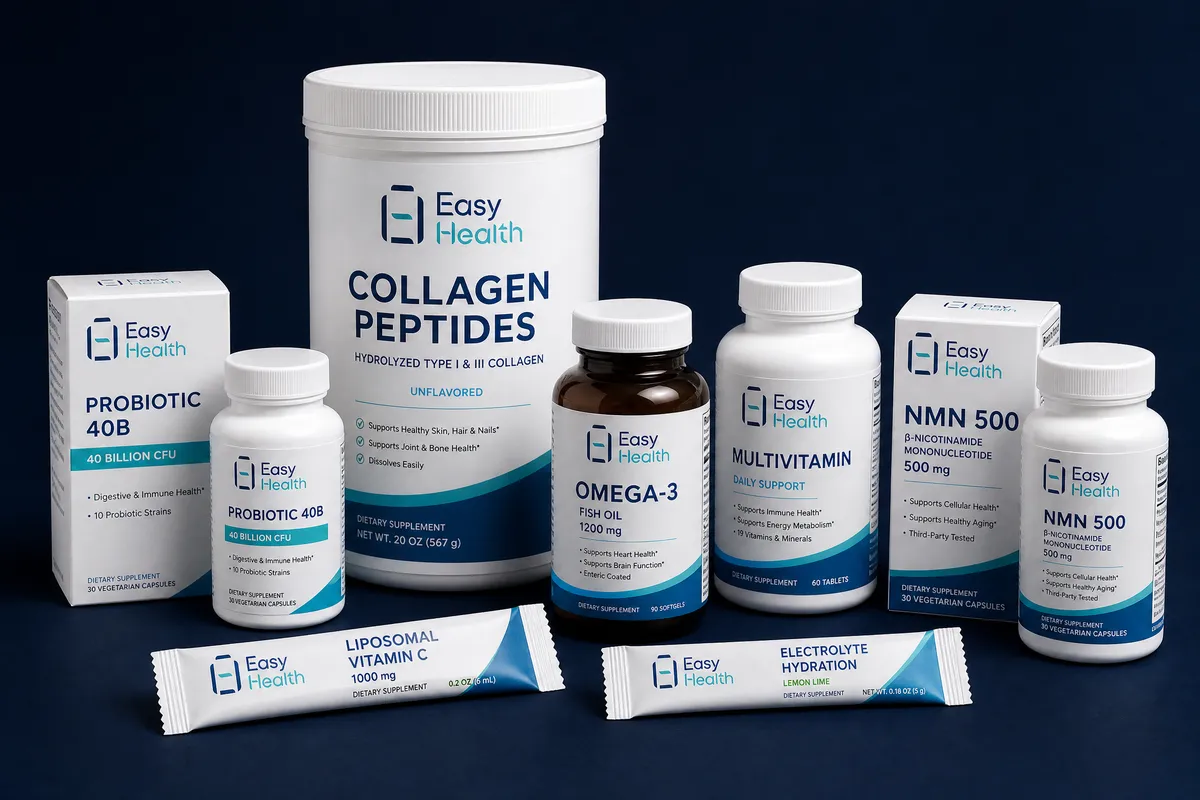
Function 1: Product protection — Active ingredients in health supplements (such as probiotics, NMN and vitamin C) are highly sensitive to light, oxygen and humidity. Packaging must provide sufficient barrier performance to ensure stability and efficacy throughout the entire shelf life. For example, probiotics require a low water activity environment (aw < 0.3), and NMN requires light protection and a low-oxygen environment. Function 2: Brand communication — In the highly competitive health-supplement market, packaging is the first touchpoint for consumers. Professional, high-quality packaging design can build trust and convey brand positioning and product value. Function 3: Regulatory compliance — Health-supplement packaging must include statutory information such as a complete ingredient list, nutrition label, health claims (if any), storage conditions and expiry date.
How to choose supplement packaging materials
HDPE (high-density polyethylene) bottles — the most commonly used container material for supplements. Advantages: excellent moisture resistance, good chemical stability, reliable supply. Suitable for: capsules, tablets, softgels. Note: opaque, suitable for light-sensitive products. PET (polyethylene terephthalate) bottles — advantages: high transparency to showcase the product; lightweight and durable. Suitable for: gummies, coloured capsules and other products that benefit from visibility. Note: lower barrier than HDPE and not ideal for oxygen-sensitive products. Glass bottles — advantages: zero migration risk, premium feel, recyclable. Suitable for: liquid supplements (oral liquids, enzyme drinks) and premium brands. Note: heavier, greater transport burden, fragile. Aluminium pouches/sticks — advantages: excellent barriers (oxygen, light and moisture) and portability. Suitable for: powders (collagen, protein) and probiotics. Note: cannot be reclosed after opening; single-use required. Blister packs — advantages: precise dosing, individually sealed, very good moisture protection. Suitable for: high-value capsules (NMN, CoQ10) and products requiring accurate doses. Note: higher overall outlay, but can effectively extend shelf life.
| Topic | Key Summary |
|---|---|
| The three core functions of health supplement packaging | Function 1: Product protection — Active ingredients in supplements (such as probiotics, NMN, vitamin C) are highly sensitive to light, oxygen and humidity. Packaging must provide sufficient barrier. |
| In-depth Analysis of Supplement Packaging Materials | HDPE (high-density polyethylene) bottles — the most common packaging material for health supplements; advantages: excellent moisture resistance, good chemical stability, and stable supply; suitable for capsules, tablets, and softgels. |
| Supplement Packaging Design and Brand Strategy | Strategy 1: Differentiated positioning — Standing out on the shelf is the first step. Analyze competitors' packaging styles to identify a distinctive visual entry point. For example, if most collagen products on the market. |
| Supplement Packaging Printing Options | Printing processes, applicable scenarios, and effects: Offset printing – high-volume cartons/labels, accurate colour and rich detail; Digital printing. |

Supplement packaging design and brand strategy
Strategy 1: Differentiated positioning — Standing out on the shelf is the first step. Analyse competitors’ packaging styles to identify a differentiated visual entry point. For example, if most collagen products on the market use pink tones, you could try a premium deep blue + gold route. Strategy 2: Building trust — Health-supplement consumers place particular emphasis on trust. Highlight elements such as certification marks (GMP, FSSC), QR codes for test reports, and patented ingredient identifiers on the packaging. Strategy 3: Information hierarchy — The front of pack should highlight the brand name and core proposition (conveyed within 3 seconds); the side should provide detailed ingredients and usage; the back should contain statutory labelling information. Strategy 4: Serialised design — If the brand has multiple SKUs, adopt a unified design system and differentiate products by colour or pattern to build brand recognition. Strategy 5: Unboxing experience — In the e-commerce era, the unboxing experience has become a key touchpoint for brand communication. Thoughtfully designed inserts, thank-you cards and product manuals can enhance customer satisfaction and social sharing rates.
Need a Professional Manufacturing Solution?
Complimentary project consultation with dedicated follow-up based on your product needs. Small-batch sampling is available, and production batch sizes are confirmed per project.

Printing options for supplement packaging
Printing processes, applicable scenarios, and effects: Offset printing – high-volume cartons/labels, accurate colour and rich detail; Digital printing – small-batch/personalisation, flexible and versatile; Hot stamping (gold/silver) – premium brands, metallic lustre and luxury; Spot UV varnish – emphasis areas, glossy contrast and tactile feel; Embossing/debossing – tactile experience, three-dimensional texture; Screen printing – direct printing on bottles, durable and non-peeling. Recommendation: start-up brands can begin with digitally printed labels (suited to small batches and rapid iteration), and once sales stabilise, evaluate offset-printed cartons as needed (more stable colour and quality at high volumes). Production batches for each process will be confirmed by your account manager on a project basis.

Quality control checks for supplement packaging
Seal tests - Bottle cover twirling tests are secure, preventing oxygen and water from entering. Standard twister value: 28mm bottlecap 1.0-1.5 N. m, 38mm bottlecap 1.5-2.0 N.m. Insistence tests – Measurements of oxygen throughput (OTR) and water vapour throughput (WVTR) of packaged materials ensure that the quality-of-product requirements are met. Print quality - Colour differences are controlled in ΔE < 3, text clarity, bar code readability and image-specific accuracy. Material compatibility - make sure that packages and product components do not react chemically, especially liquid and semi-solid products. The drop test – Simulating the impact of the transport process to ensure that the package protects the product from damage. Accelerating the aging test — testing the long-term stabilization of the package under high-temperature, high-wet conditions, and verifying the quality period.

Key components of supplement packaging planning
The packaging outlay forms a defined part of overall product planning. Key components include: bottles/containers; labels/printing; seals and accessories (such as foil seals, desiccants and cotton fillers); outer cartons and logistics packaging (such as corrugated boxes, cushioning and shrink film); and one-off design inputs (such as label and carton design). Optimisation strategies: 1) plan production volumes sensibly to improve overall efficiency; 2) prioritise standard containers to avoid new tooling and shorten development time; 3) use special finishes (e.g., hot stamping, embossing) selectively and control coverage; 4) allow multiple SKUs to share the same container and structure, changing only labels and inserts. Your client manager will assess each project and advise based on formula, packaging and quantity.
Supplement packaging trends for 2026
The first trend is that PCR materials, bio-based plastics and compost packages are mainstreamed. More and more consumers (especially the Z generation) use environmental packages as a factor in purchasing decisions. Trend two: Technology applications such as smart packaging - NFC chip protection, temperature indicator tags, and AR interactive experience are becoming more common. The trend is three: personalization and customization - digital printing makes it possible to package small quantities of individualized packages. A limited edition, a holiday version and a combined KOL version package became a distributor. The idea of "Less is More" is particularly popular in high-end health markets. Clear information layers, large amounts of white and high-quality material qualities replace excessive decorations. The trend is five: functional innovation — functional innovations such as measuring covers, child safety covers, and open-ended design to improve user experience.
Article Recap
- The three core functions of health supplement packaging
- In-depth Analysis of Supplement Packaging Materials
- Supplement Packaging Design and Brand Strategy
- Supplement Packaging Printing Options
- The Importance of Supplement Packaging Quality Control
Easy Health Chief Packaging Design Executive
2026 trends: recyclable mono-materials, reduced plastics, QR-linked batch test access and digital leaflets, clear front-of-pack information hierarchy, and e-commerce-ready protective formats.
Evidence used for product planning should identify the original study or guidance, its scope and its limitations. Review proposed product claims separately before approving label copy.
Supplement Packaging Guide FAQs
What are the most important considerations in health packaging?
The primary consideration is product stability – the selection of materials that can effectively block oxygen, moisture, and light, and ensure that active ingredients remain effective throughout their shelf life. Next is the rule of law and branding.
How long does it take to package health care?
It usually takes 2-4 weeks from concept to finalization. These include: brand strategy communication 2-3 days, pre-draft design 5-7 days, amendment confirmation 3-5 days, pre-print production 2-3 days. An extra week is required to make a product picture.
How to choose the color of the healthcare bottle?
Dark bottles (amber, dark blue) are suitable for products that need light avoidance (e.g. NMN, vitamin C); transparent/semi-transparent bottles are suitable for products that need to be displayed (e.g. coloured fudge, capsules); and white bottles are the most common option for most products.
How can small brands create effective packaging with limited resources?
Recommendations: 1) Use standard bottles with pressure-sensitive labels (an entry option). 2) Invest in design rather than processes; strong design is often more effective than hot stamping. 3) Start with 1–2 core SKUs, validate the market, then expand. 4) Choose a packaging company that supports small batches, such as Easy Health.
What tests are needed for health kits?
Tests will be performed: sealed tests, barrier tests (OTR/WVTR), material compatibility tests, accelerated ageing tests. It's recommended: drop test, printing with force test, color differential test. The export product also needs to be tested on a specific target market.
Want to know more about contract manufacturing?
Our professional team will provide you with free counselling at any time.
Free WhatsApp Consultation