Bilingual health supplement label details for Hong Kong
Getting health food labels right starts with scope, then step-by-step checks: core particulars, the 1+7 nutrition label, bilingual layout, and claim controls. This page provides actionable checklists and layout tips to complete design and mock-ups within the regulatory framework; timelines vary by project and are confirmed by our account manager.
Summary:This page covers prepackaged food label planning in Hong Kong: determine whether food-labelling and nutrition-labelling rules apply, confirm product-specific language requirements or exemptions, and review proposed claims. Easy Health coordinates design, mock-ups and label-data checks for the project. Confirm which certificate scopes and supporting documents apply before artwork approval.
Which health foods must follow Cap.132W and the Hong Kong nutrition label scheme?
Health foods that meet the definition of “food” and are sold prepackaged must be labelled under Schedule 3 of Cap.132W with the name of the food, the ingredient list, a “best before” or “use by” date, any special storage or usage instructions, the numerical count or net weight/volume, and the name and address of the manufacturer or packer (where the Schedule 3 exemption conditions are met, the country of origin and the Hong Kong distributor or brand owner may be shown instead). Labels may be in Chinese or English; if both are used, the food name and ingredient list must appear in both. A “1+7” nutrition label is generally required, and an exempted product loses its exemption once it makes a nutrition claim.
When do health foods follow Cap.132W?
First determine if the product is a “food” and sold as a prepackaged item. If yes, labels must follow Hong Kong Cap.132W for required particulars. Where nutrition information is involved, the 1+7 scheme typically applies. Note: Cap.132W and the 1+7 scheme apply to prepackaged foods, not to medicines or cosmetics; for Mainland China, refer to GB 7718 and GB 28050. Markets differ in language, units and placement—plan the layout early to avoid rework. Easy Health can coordinate packaging structure, label layout and mock-ups, and assist in checking that key fields are present.
- Confirm it is a prepackaged food
- Match market of sale to regulations
- Reserve space for bilingual/legal fields
- Align units and values with the market
Core particulars under Cap.132W: item-by-item
For prepackaged foods, Schedule 3 of Cap.132W requires: the name of the food; an ingredient list in descending order of weight or volume; a “best before” or “use by” date; statements of any special storage conditions or usage instructions; the numerical count or net weight/volume; and the full or business name and address of the manufacturer or packer. A Schedule 3 exemption may apply where the label shows the country of origin and the name and address of the Hong Kong distributor or brand owner, and the manufacturer’s address has been notified to the authority in writing. Labels may be in Chinese or English; if both are used, the food name and ingredient list must appear in both. Grouping statutory fields in one visual area helps avoid omissions; Easy Health coordinates label and carton artwork alignment and trial prints so legibility can be reviewed before production.
- Plain, recognisable food name
- Ingredients in descending order
- Correct date wording and storage
- Manufacturer or packer name and address (or exemption route)
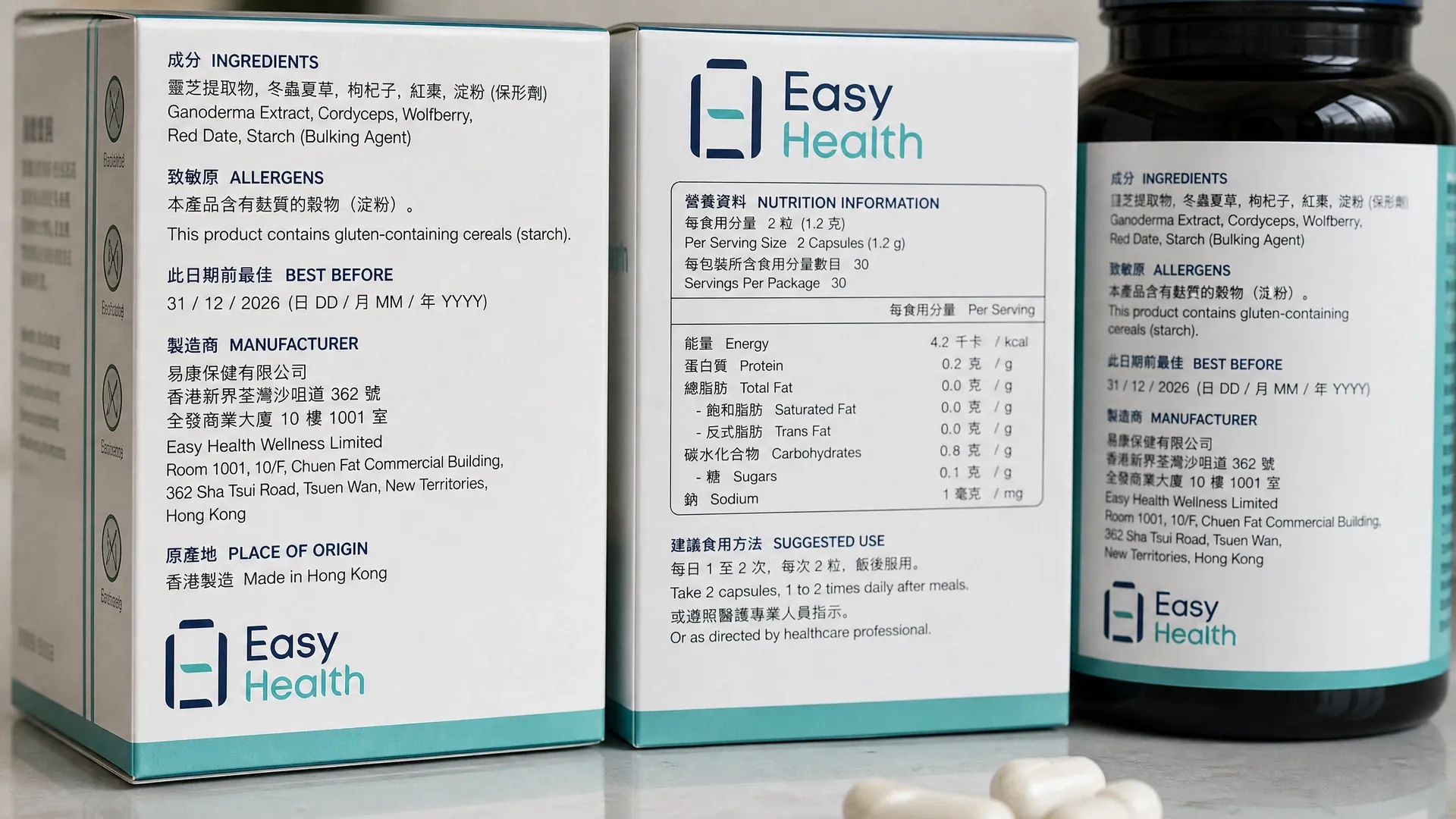
Visual examples: placing statutory fields and the nutrition table prominently
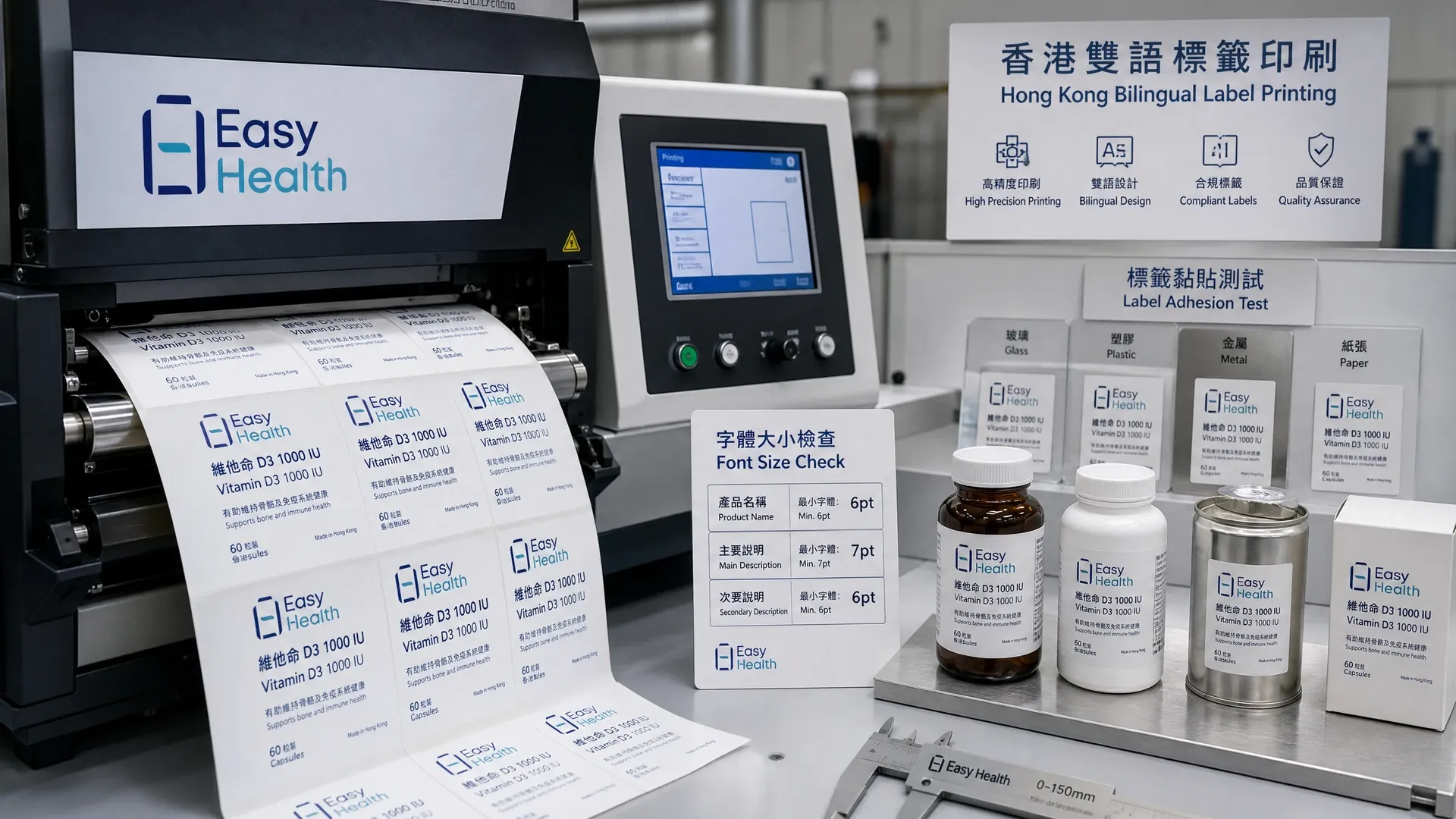
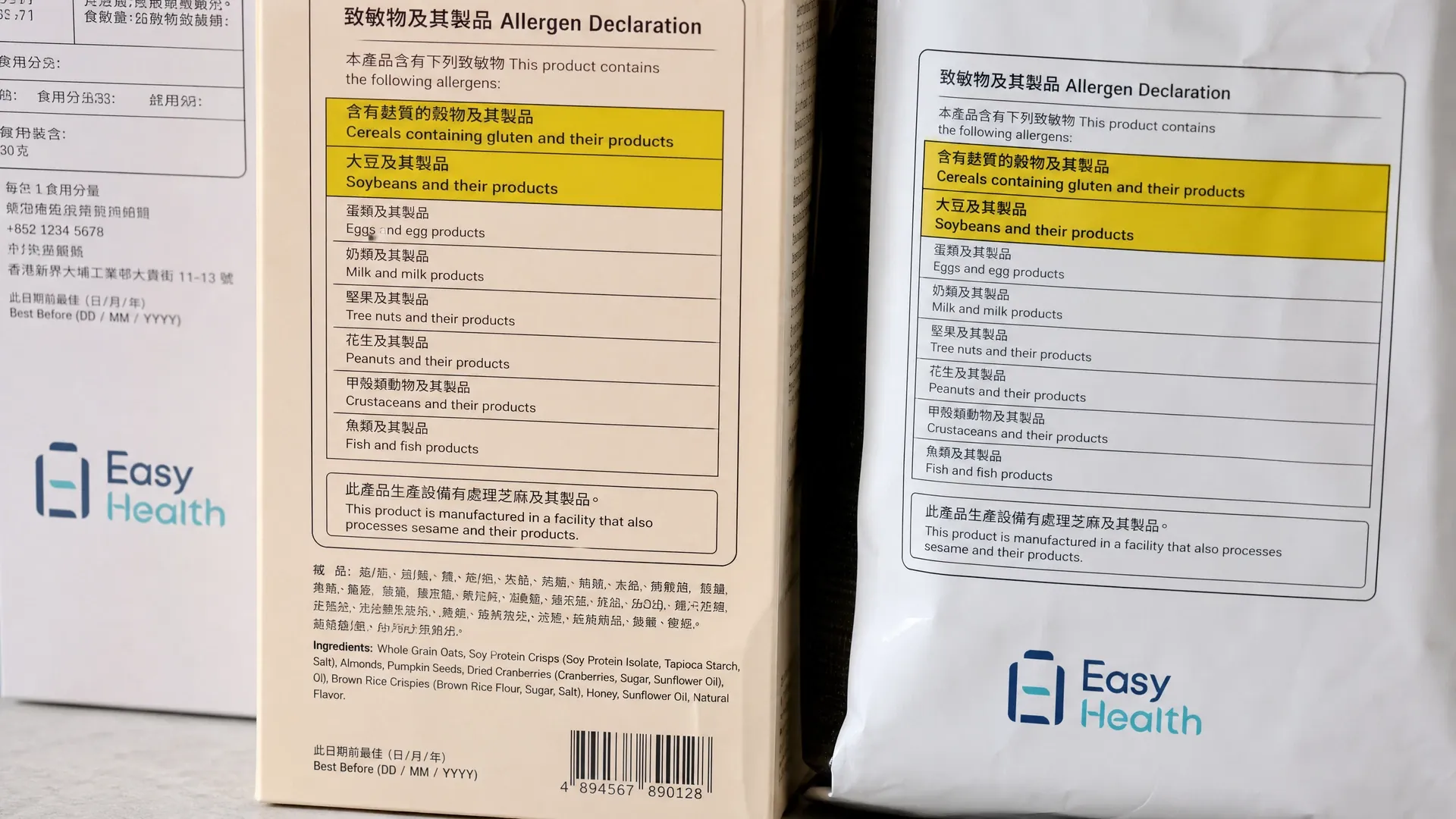
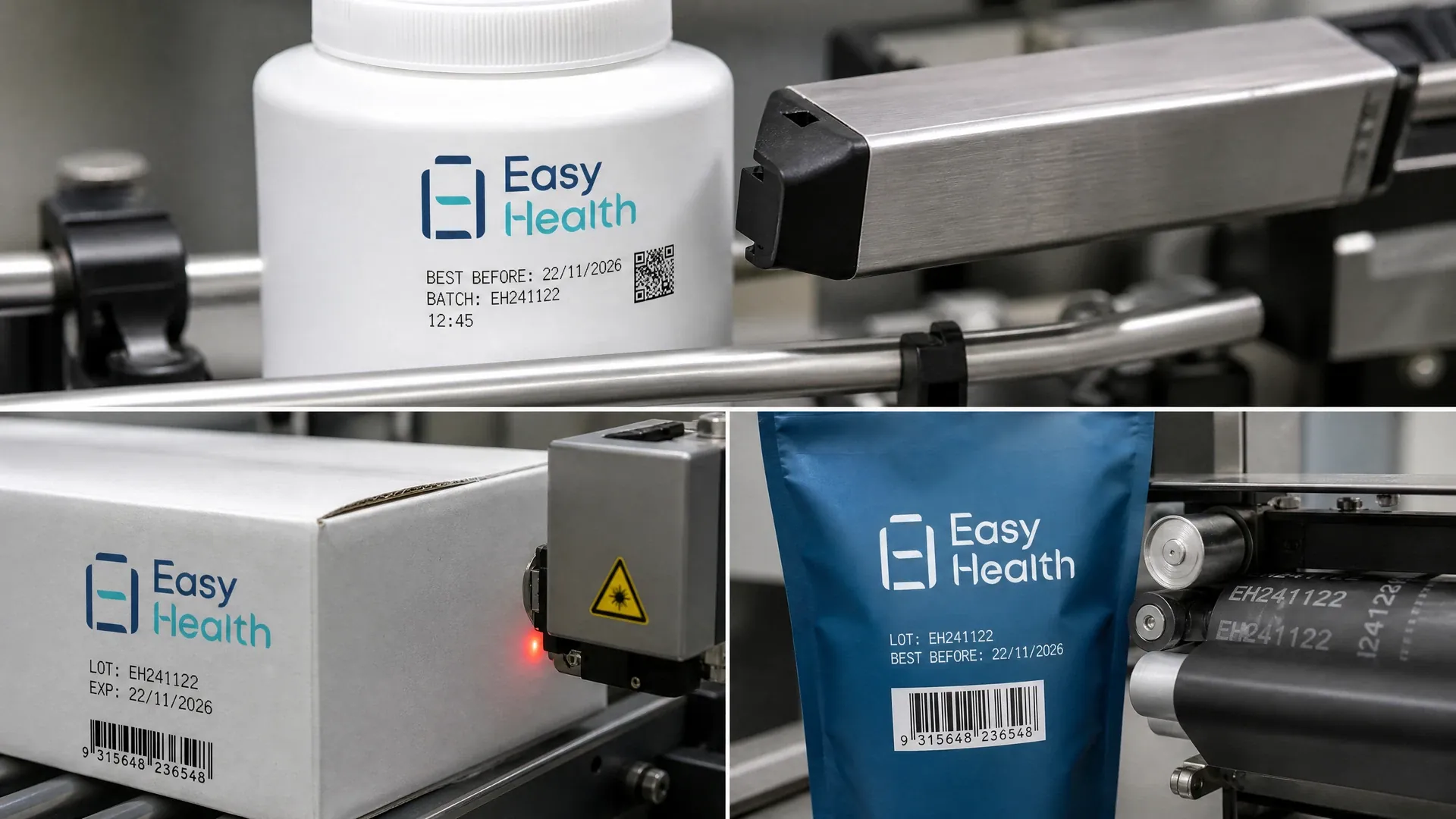
Use the visuals to locate common positions for core particulars, see tabular vs linear 1+7 nutrition formats, date-and-storage phrasing, and bilingual side-by-side layouts. Pay attention to heading hierarchy, unit placement and number alignment.
Hong Kong nutrition label presentation and pitfalls
The 1+7 scheme covers energy plus seven specified nutrients: protein, carbohydrates, total fat, saturated fat, trans fat, sodium and sugars, shown per 100 g/ml or per serving. Use a tabular format in a prominent position; a linear format may be used if total surface area is under 200 cm². If the label is bilingual, the nutrition label must also be bilingual. Common pitfalls: omitting trans fat; inconsistent units/decimals; mixing per 100 g with per serving; making nutrition claims without the 1+7 panel. For multiple serving sizes or flavours, separate panels or clear conversion notes are advisable. Easy Health coordinates layout and mock-ups of nutrition information and confirms a suitable presentation per project.
- Show per 100 g/ml or per serving
- Align bilingual terms consistently
- Prefer table; linear for small packs
- Nutrition claims affect exemptions
Bilingual health supplement label layout and consistency
For bilingual labels, maintain strict consistency across terms and values. When bilingual, the food name and ingredient list must appear in both languages, and the nutrition panel must be bilingual too. To avoid clutter, group statutory fields on one panel, separating headings, units and figures clearly; for shared artwork across flavours, reserve batch and flavour identifiers. Watch units for solids vs liquids and do not confuse per serving with per package. If adding extra markets, use a two-tier information design: mandatory fields first, market text second. Easy Health coordinates Chinese–English checks and mock-ups, arranging material supply and pre-press artwork alignment.
- Map terms 1:1 across languages
- Align units, serving size and values
- Segment layout for readability
- Reserve batch and flavour IDs
How label and packaging coordination works
- Project scoping:Our account manager reviews formula, markets and pack types, confirming applicable labelling scope and space needs per project.
- Content collation and drafts:Compile food name, ingredient list, nutrition data, date and storage lines; prepare bilingual drafts and a glossary.
- Layout and technical specs:Plan zones for statutory fields, weights and alignment; coordinate material choices, print orientation and barcode area.
- Mock-up and legibility check:Arrange mock-ups or digital proofs to review size, contrast and legibility, adjusting where needed.
- Production coordination and final checks:Coordinate packaging production and pre-press alignment; our account manager checks key fields and language consistency.
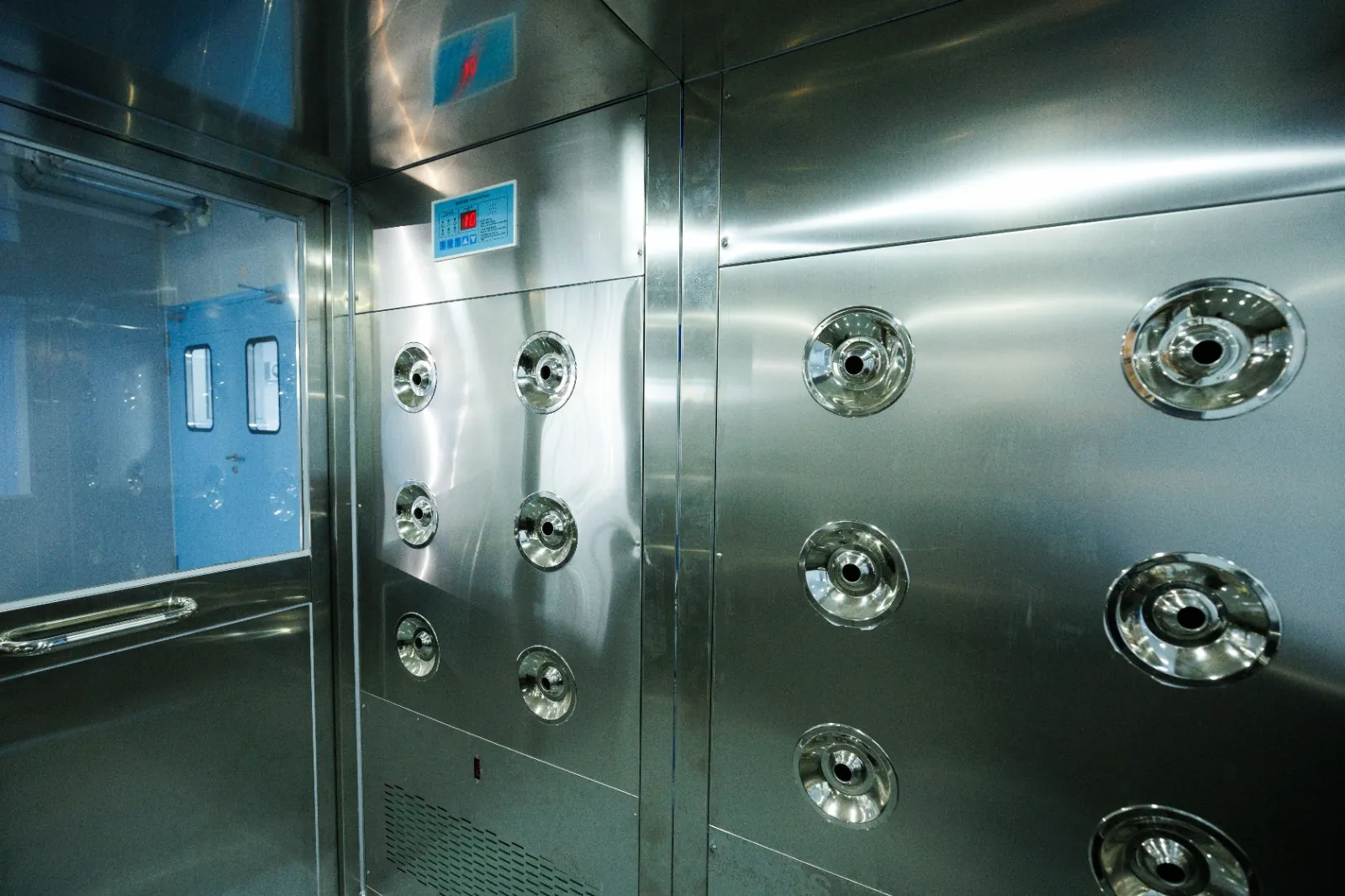
Inside the Easy Health Hong Kong Facility


Comparison of nutrition information formats
| Item | Per 100 g/ml | Per serving | Table vs linear format |
|---|---|---|---|
| Best used for | Cross-flavour consistency | Highlight suggested serving | A table is generally required |
| Reader clarity | Good for product comparison | Good for intake context | Tables read clearly; small packs may use linear |
| Common pitfalls | Mixed with per serving | Missing serving size/count | Unit/decimal inconsistencies |
| Space needs | More fixed footprint | Requires serving info | Tables need space; linear saves room |
Nutrition information must be shown as a table in a conspicuous position; packs with a total surface area under 200 cm² may use a linear format. If the label is bilingual, the nutrition label must be bilingual too.
Pre-submission label checklist
- Confirm it is a prepackaged food under Cap.132W
- Food name and ingredients (bilingual if applicable)
- 1+7 nutrition units and presentation format
- Complete date wording and storage directions
- Net content with correct measurement units
- Manufacturer/packer name and address, or country of origin plus Hong Kong distributor where exempt
Bilingual health supplement label FAQs
Do ingredients need to be bilingual?
Either Chinese or English is acceptable; if the label is bilingual overall, the food name and ingredient list must be shown in both languages. Prepare a terminology list for botanicals, sweeteners and allergens to avoid inconsistent translations. Easy Health can coordinate bilingual checks and mock-ups.
Should I use per 100 g/ml or per serving?
Both are acceptable but keep the panel consistent. Per serving is intuitive for single-serve items; per 100 g/ml facilitates comparison across products. You may include both, ensuring units are not mixed.
Can I use a linear format for small packs?
If total surface area is under 200 cm², a linear format may be used for the 1+7 scheme. Maintain prominence and clarity. If the label is bilingual, the nutrition panel must be bilingual as well.
What does health supplement claims regulation mean for labels?
The Undesirable Medical Advertisements Ordinance (Cap.231) regulates medical or health-related claims. Schedule 4 lists six prohibited categories for oral products, covering prevention, removal or treatment related to breast lumps, the reproductive or urinary system, the endocrine system, blood glucose, blood pressure, and blood lipids/cholesterol. False trade descriptions are regulated by the Trade Descriptions Ordinance (Cap.362). Seek advice from the Department of Health or professional advisers.
How should I prepare artwork and the barcode zone?
Reserve zones early for statutory fields, the nutrition panel, barcode and batch code; include proper bleed and safe margins. Once print direction and material finish are set, fine-tune weights and contrast for legibility. Easy Health coordinates material supply, pre-press alignment and trial prints.
Related Packaging Services
Discuss your supplement label and packaging plan
Chat with an Easy Health account manager on WhatsApp about product data, label layout and mock-up arrangements. From our Hong Kong facility, we coordinate labels, cartons and multiple packaging formats per project needs.
Last updated: